
LI MEDIATION
LI Mediation Platform for Multi-Vendor Networks
The core layer between your network and law enforcement. Collect, filter and format intercepted data, then deliver it to every authorized agency in the required format.
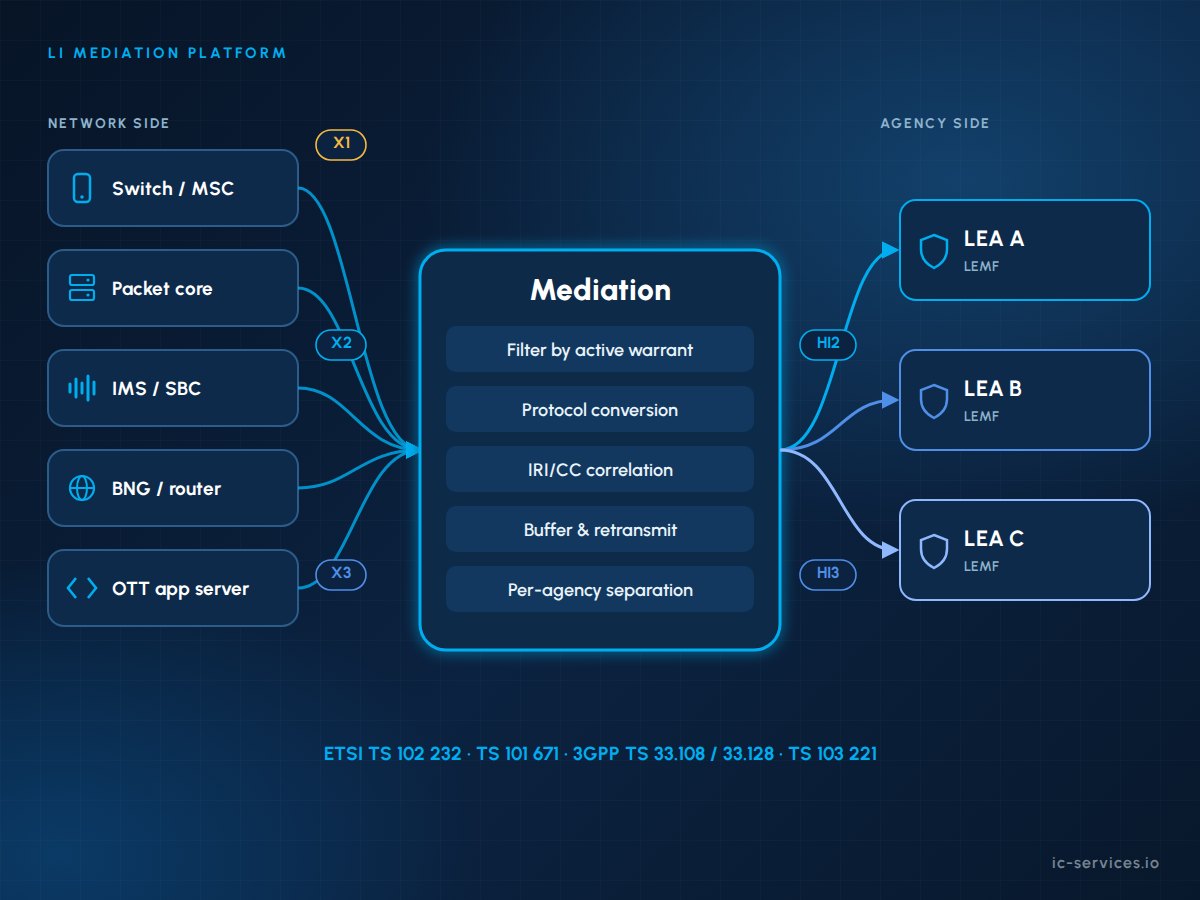
An LI mediation platform is the layer between a communications network and law enforcement agencies that turns raw intercepted traffic into lawful handover. It collects content and metadata from network elements, filters them by active warrant and delivers them in standardized formats. The ICS LI mediation platform does this for fixed, mobile, VoIP, broadband and OTT services.
Key facts
- Bridges CSPs/ISPs and LEAs: collection on the network side, handover on the agency side.
- Interfaces: X1/X2/X3 towards the network, HI1/HI2/HI3 towards agencies.
- Formats: ETSI and 3GPP handover specifications, national profiles and multiple versions.
- Vendor-independent: works with switches, routers, gateways and application servers from different vendors.
- Parallel delivery: multiple agencies at once, with strict separation between them.
- Operation: browser-based UI, automated provisioning and de-provisioning, full logging.
Why do operators need an LI mediation platform?
Network elements speak vendor-specific languages. Agencies expect standardized, nationally defined formats. Without mediation, every network element would need its own direct handover to every agency.
Mediation solves this problem in one place. It isolates the network from the agencies, applies the warrant scope and ensures consistent delivery. When a network vendor changes or a handover standard is updated, only the mediation layer needs to adapt.
Core functions of the ICS LI mediation platform
01
Data collection and mediation
Collects intercepted data from switches, routers, gateways and application servers. Filters it so that only traffic covered by active warrants is processed.
02
Handover delivery
Delivers intercept related information (IRI) and content of communication (CC) to LEMFs. Serves multiple agencies in parallel with strict separation.
03
Protocol conversion
Converts vendor-specific output into national and international handover profiles. Supports several versions of the same standard side by side.
04
Management and control
Handles warrant lifecycle, target provisioning, POI configuration, logging and audit. Works standalone or under the control of ICS LIMS.
How does LI mediation work?
1
Provisioning
A warrant is activated. The target is provisioned on the points of interception (POIs) and the mediation function via X1.
2
Collection
POIs in the network send intercept related data via X2 and content via X3.
3
Filtering and correlation
The platform checks each record against active warrants and correlates IRI with the matching CC.
4
Conversion
Data is formatted to the handover profile each agency requires, for example ETSI TS 102 232 or 3GPP TS 33.128.
5
Delivery
IRI is sent via HI2 and CC via HI3 to every authorized LEMF, separated per agency and per warrant.
6
Logging and audit
Every delivery, error and configuration change is recorded for supervision and audits.
Which standards does the platform support?
The platform follows ETSI and 3GPP specifications. National profiles, such as the German TR TKÜV, are configured on top.
| Standard | Scope |
|---|---|
| ETSI TS 103 221-1 | X1: target provisioning towards network elements and mediation |
| ETSI TS 103 221-2 | X2/X3: delivery of IRI and content from POIs to mediation |
| ETSI TS 103 120 | HI1: electronic warrant exchange with agencies |
| ETSI TS 102 232-1 to -7 | HI2/HI3 handover for IP-based services |
| ETSI TS 101 671 | HI2/HI3 handover for circuit-switched services |
| ETSI TS 103 707 | Handover of messaging services over HTTP/XML |
| 3GPP TS 33.106 / 33.107 / 33.108 | LI requirements, architecture and handover up to 4G and IMS |
| 3GPP TS 33.126 / 33.127 / 33.128 | LI requirements, architecture and protocols for 5G |
Integration and operation
The ICS LI mediation platform connects to the systems you already run. It is vendor-independent and uses standardized interfaces wherever the network allows it.
- Mobile cores, including 4G, IMS and 5G.
- Fixed and broadband access networks.
- VoIP platforms and OTT application servers.
- ICS LIMS or other management systems.
- Billing and logging systems.
A browser-based UI gives operators a clear view of targets, deliveries and alarms. Automated provisioning and de-provisioning reduce manual work and the risk of errors.
Customizable workflows
01
Approval flows
Define who may activate, change or end an interception, and in which order approvals happen.
02
Notifications
Alert operations staff when deliveries fail, targets expire or configuration drifts from the warrant.
03
Reporting
Generate reports for internal controls, regulators and agencies. Workflows fit ETSI-based and CALEA-oriented environments.
Who needs lawful interception mediation?
Mobile network operators, fixed-line operators, ISPs, VoIP providers and OTT service providers all need mediation when they deliver interceptions. MVNOs and operators with outsourced core networks need it as well, although the responsibilities are split differently.
Agencies benefit indirectly. They receive consistent, standards-based data from every provider, which simplifies reception in their LEMF.
Why ICS
01
Strategic consulting
We help you define your LI architecture, choose interfaces and plan for new services such as 5G.
02
Compliance and audits
We prepare you for regulatory checks. ICS holds multiple BNetzA acceptances for interception solutions.
03
Implementation and migration
We integrate the platform, migrate existing interceptions and support you in operation, with security-cleared staff and more than 20 years of experience.
Frequently Asked Questions
What is an LI mediation platform?
An LI mediation platform is the system that sits between a communications network and law enforcement monitoring facilities. It receives intercepted data from network elements, filters it by active warrant, converts it into standardized handover formats and delivers it to authorized agencies. It also logs every step. In 3GPP and ETSI terminology, it implements the mediation and delivery functions.
What is the difference between IRI and CC?
Intercept related information (IRI) is metadata about a communication, such as participants, time, duration and location. Content of communication (CC) is the actual content, for example voice, messages or IP packets. The mediation platform delivers IRI via HI2 and CC via HI3. It correlates both so that the agency can match each content stream to its metadata.
Can the platform deliver to several agencies at once?
Yes. The ICS LI mediation platform delivers to multiple agencies in parallel. Each delivery is strictly separated, so one agency never sees data belonging to another agency’s warrant. Each agency can also receive a different handover profile or standard version. This matters when federal and state authorities, or authorities in different countries, are involved.
Does the platform work with network equipment from different vendors?
Yes. The platform is vendor-independent. It collects data from switches, routers, gateways and application servers of different vendors and converts their output into national and international profiles. Where network elements support ETSI TS 103 221, it uses the standardized X1/X2/X3 interfaces. Where they do not, vendor-specific adapters are used.
How does the mediation platform work with ICS LIMS?
ICS LIMS manages warrants and provisions targets. The mediation platform processes and delivers the intercepted traffic. Together they form a complete operator-side LI chain with one audit trail. The mediation platform can also work with management systems from other vendors, and ICS LIMS can control mediation devices from other vendors.
Is the LI mediation platform ready for 5G?
Yes. The platform supports the 3GPP LI specifications for 5G: TS 33.126, TS 33.127 and TS 33.128. For earlier networks and IMS, it supports TS 33.106, TS 33.107 and TS 33.108. Towards the 5G core it uses the X1/X2/X3 interfaces defined in ETSI TS 103 221. Our consultants help you plan the transition.
Modernize your LI mediation
Talk to our engineers about your network vendors, services and national handover profile. We will show you how the platform fits.