
LAWFUL INTERCEPTION
Lawful Interception Solutions for Networks, OTT and 5G
Standards-based interception for fixed, mobile, IMS, OTT and connected-vehicle services, delivered by a Cologne team with multiple BNetzA acceptances and security-cleared staff.
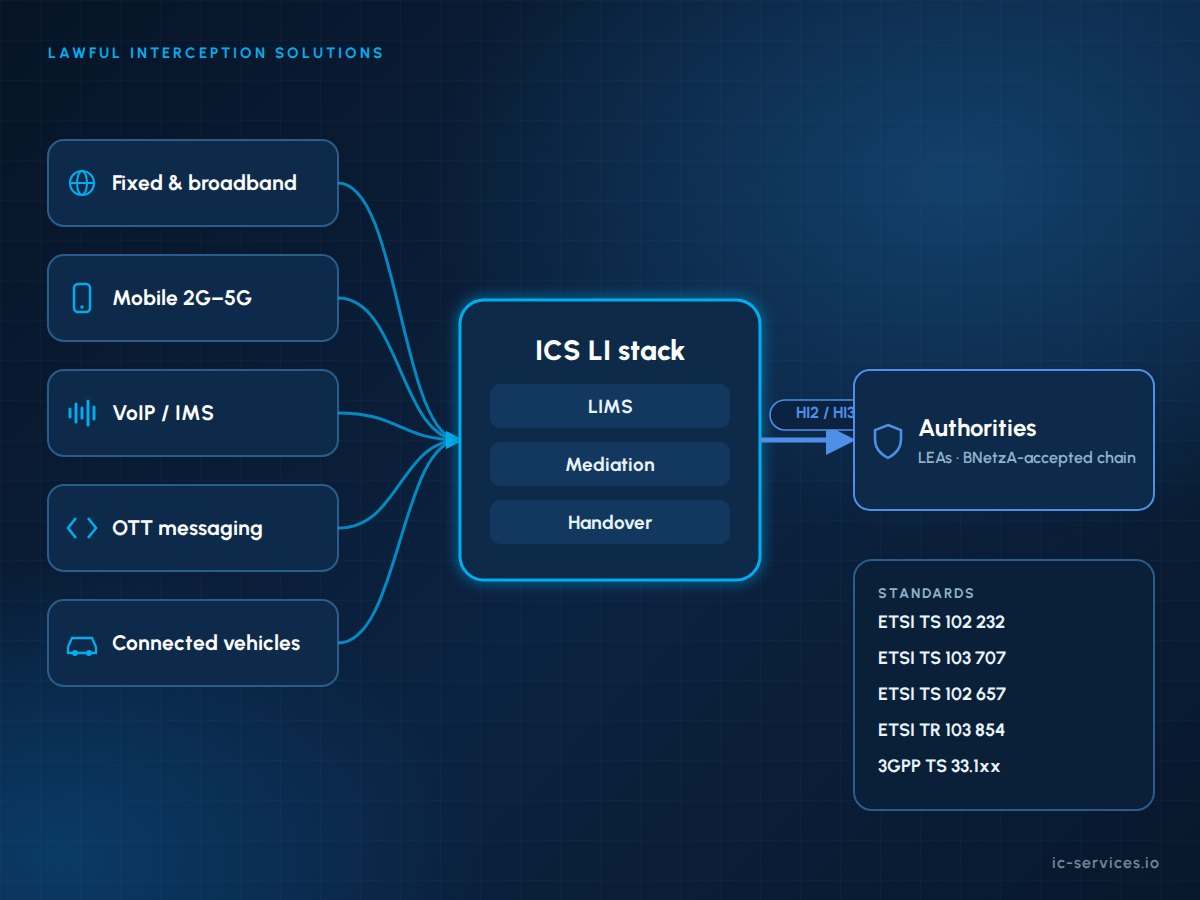
Lawful interception solutions are the systems and processes that let network operators and service providers deliver communications to authorized agencies under a legal order. They cover target provisioning, data capture, mediation and standardized handover. ICS provides lawful interception solutions for traditional telecom networks, 3GPP mobile networks including 5G and IMS, OTT services, retained data and connected vehicles.
Key facts
- Legal basis in Germany: § 170 TKG, the TKÜV and the TR TKÜV.
- Standards: ETSI TS 102 232, TS 103 707, TS 102 657, TR 103 854 and 3GPP TS 33.106/33.107/33.108, plus TS 33.126/33.127/33.128 for 5G.
- Coverage: fixed, mobile, IMS, 5G, OTT, retained data and connected vehicles.
- Track record: more than 20 years of experience and multiple BNetzA acceptances, including AKÜ.
- Timeline: 4-12 weeks for a standard LIMS integration, 3-6 months for a full turnkey project.
- People: staff security-cleared by the German Federal Ministry of the Interior.
What do lawful interception solutions need to deliver?
In Germany, § 170 TKG obliges operators of publicly available telecommunications services to provide technical facilities for interception. The TKÜV sets the organizational and technical rules. The TR TKÜV defines the technical details, including the handover interfaces to agencies.
Operators must also demonstrate to the Bundesnetzagentur (BNetzA) that their facilities meet these requirements. This acceptance procedure (Abnahme) is often the most demanding step of a project. It needs complete documentation, working test cases and correct handover to the authorized agencies.
A working setup delivers two data streams. Intercept-related information (IRI) describes who communicated, when and where. Content of communication (CC) carries the actual voice, messages or data. Both must reach one or more agencies in the correct format and without delay.
For the fundamentals, read our guide on what lawful interception is.
Small-provider exemption. Under the TKÜV, operators of systems with no more than 10,000 connected users do not have to keep permanent interception facilities in place. They must still implement interception orders when an agency serves one. A temporary LI box is a practical way to meet that obligation.
Lawful interception solutions by network and service
ICS structures its portfolio in modules that share one management and mediation layer.
01
IP-based lawful interception
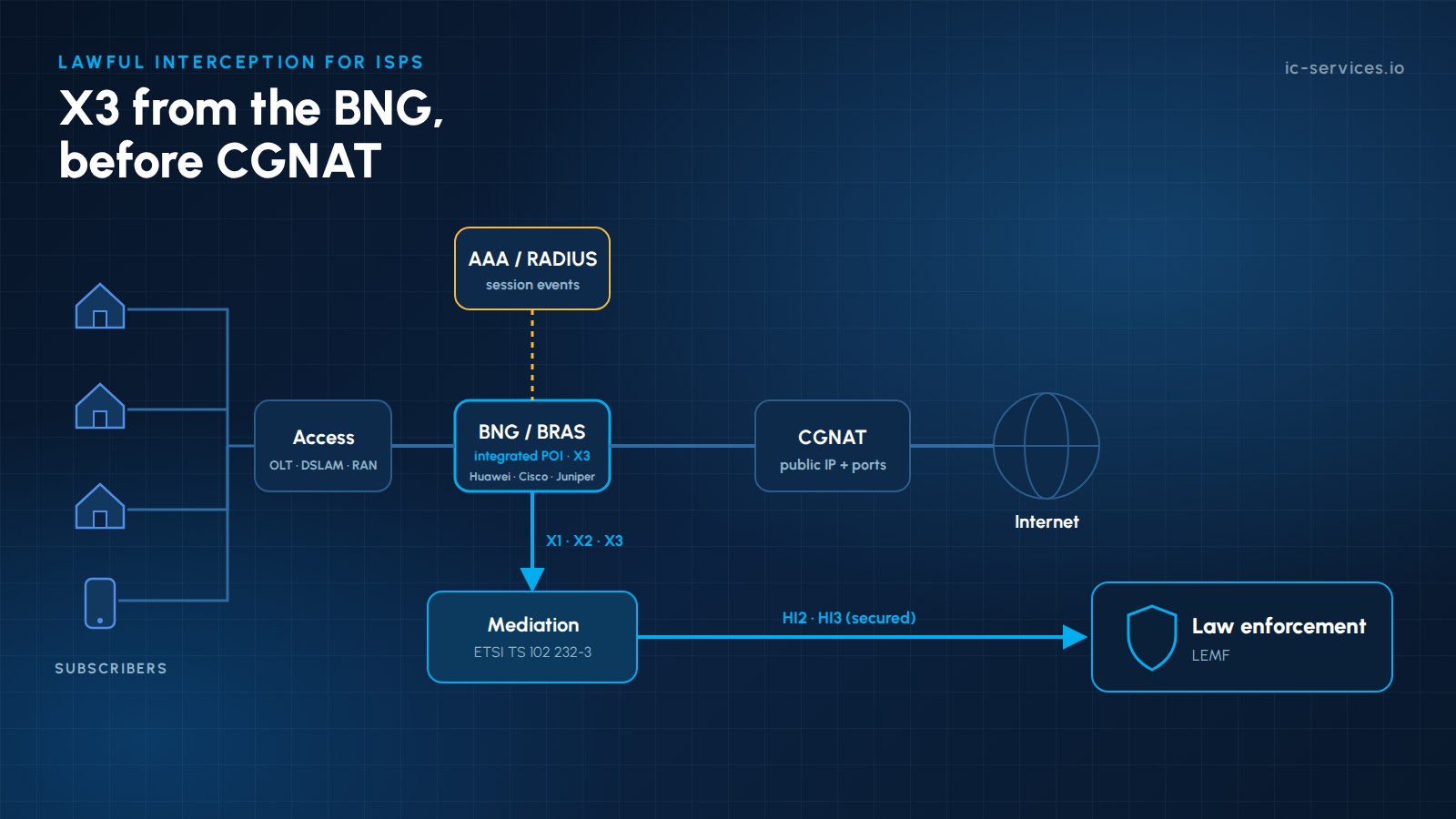
Interception for fixed, mobile and IMS cores with HI2 and HI3 handover according to ETSI TS 102 232. BNG/BRAS and carrier-grade routers copy the target’s traffic themselves and deliver it via X3. One platform can serve multiple agencies in parallel. Learn more
02
OTT and web services
Handover for messaging and collaboration services over HTTP/XML according to ETSI TS 103 707. It gives OTT providers a defined, standards-based way to deliver data to agencies.
03
3GPP LI for mobile and 5G
Interception in packet cores and IMS, with IRI and CC captured at the relevant reference points. Support follows 3GPP TS 33.106/33.107/33.108 and TS 33.126/33.127/33.128 for 5G. Learn more
04
Connected vehicles
Request handling for automotive data based on ETSI TR 103 854. It covers VIN-based requests, identifier mapping and integration with response processing systems. Learn more
05
Usage and subscriber data
Disclosure of retained and subscriber data with handover according to ETSI TS 102 657. Data minimization and defined retention periods are built into the workflow. Learn more
06
Germany: AKÜ
Auslandskopfüberwachung (AKÜ) covers cross-border interception of foreign target identifiers in German networks. ICS provides jurisdiction-aware routing, logging and reporting, and supports the BNetzA procedure.
How does an LI project run from gap analysis to BNetzA acceptance?
Most projects follow the same six steps, whatever the network size.
1
Gap analysis
We compare your network, services and existing LI setup with § 170 TKG, the TKÜV and the TR TKÜV.
2
Architecture and design
We define interception points, mediation, handover interfaces and the agencies to be served.
3
Integration
We connect the LIMS and mediation to your core network, IMS or service platforms. Wherever possible, BNG/BRAS, routers and packet cores deliver the target’s traffic natively via X1/X2/X3, with integrations for Huawei, Cisco, Juniper and other leading vendors.
4
Testing
We run end-to-end tests of provisioning, IRI and CC delivery and handover formats.
5
Documentation and acceptance
We prepare the required documentation and support you through the BNetzA acceptance procedure.
How long does deployment take?
A standard LIMS integration into an existing IP or VoIP network typically takes 4-12 weeks. Plug-and-play appliance setup keeps on-site work short.
A full turnkey project takes 3-6 months. That scope includes custom mediation, multi-agency handover and the regulatory acceptance procedure.
The main factors that affect the timeline are:
- the number of network elements and services in scope
- the handover interfaces each agency requires
- custom mediation for non-standard data sources
- availability of test slots with agencies and the BNetzA
Which standard applies to which service?
The table shows the main handover and interface standards for each service type. Your exact profile depends on the national requirements that apply to you.
| Service or interface | Relevant standard |
|---|---|
| IP data, fixed and mobile, IMS | ETSI TS 102 232-1 to -7 |
| Circuit-switched voice | ETSI TS 101 671 |
| Mobile networks up to 4G and IMS | 3GPP TS 33.106, TS 33.107, TS 33.108 |
| 5G networks | 3GPP TS 33.126, TS 33.127, TS 33.128 |
| Internal interfaces X1/X2/X3 | ETSI TS 103 221-1 and -2 |
| Warrant interface (HI1) | ETSI TS 103 120 |
| OTT messaging and collaboration | ETSI TS 103 707 |
| Retained and subscriber data | ETSI TS 102 657 |
| Connected vehicles | ETSI TR 103 854 |
| National rules in Germany | § 170 TKG, TKÜV, TR TKÜV |
For background on the interface model, see our articles on HI1, HI2 and HI3 and IRI versus CC.
Who benefits from ICS lawful interception solutions?
01
Network operators
Mobile and fixed-line operators get a single platform for legacy, IP, IMS and 5G interception. Telecoms industry
02
ISPs and OTT providers
Internet service providers and OTT services get standards-based handover without building LI expertise in-house. Small providers can meet order-based obligations with a temporary setup.
03
Law enforcement and regulators
Agencies and regulators work with a partner that understands both the network side and the handover side. Regulators and law enforcement
Why ICS
01
More than 20 years in LI
ICS has worked in telecommunications and lawful interception for more than two decades. We know the operator view and the agency view.
02
Multiple BNetzA acceptances
Our interception solutions have passed multiple BNetzA acceptance procedures, including AKÜ. We apply that experience to every new project.
03
Security-cleared staff
Our team is security-cleared by the German Federal Ministry of the Interior and may handle classified information.
04
Full portfolio from one partner
LIMS, mediation, appliances, integration and managed operations come from one team. The same stack also supports data retention and e-Evidence.
How can you contact the ICS team?
ICS International Carrier Services GmbH, Lindenstr. 82, 50674 Cologne, Germany. Phone: +49 221 42919-0. Email: info@ic-services.io.
We deliver lawful interception solutions to operators and agencies in Germany and other countries. Use the contact page to describe your project.
Frequently Asked Questions
What is the legal basis for lawful interception in Germany?
The legal basis is § 170 of the Telecommunications Act (TKG). It obliges operators of publicly available telecommunications services to provide interception facilities and implement orders. The Telecommunications Interception Ordinance (TKÜV) adds organizational and technical rules. The Technical Directive (TR TKÜV) defines the interfaces and formats. Operators must also demonstrate compliance to the Bundesnetzagentur in an acceptance procedure.
How long does it take to deploy a lawful interception solution?
A standard LIMS integration into an existing IP or VoIP network typically takes 4-12 weeks, helped by plug-and-play appliance setup. A full turnkey project takes 3-6 months. That scope includes custom mediation, handover to multiple agencies and the regulatory acceptance procedure. The number of services, data sources and agency test slots drives the final timeline.
Do small providers need permanent interception facilities?
Under the TKÜV, operators of systems with no more than 10,000 connected users do not have to keep permanent interception facilities in place. The exemption does not remove the obligation itself. When an agency serves an interception order, the provider must still implement it. Many small providers therefore prepare a temporary setup, such as a temporary LI box, that can be activated quickly.
Does ICS hold BNetzA acceptances?
Yes. ICS holds multiple BNetzA acceptances for its interception solutions, including AKÜ. The BNetzA does not certify companies or products. It checks whether an operator’s interception facilities meet the legal and technical requirements. ICS supports customers through that procedure with documentation, test preparation and direct technical expertise from security-cleared staff.
Which standards do ICS lawful interception solutions support?
ICS lawful interception solutions support ETSI TS 102 232 for IP handover and TS 103 707 for OTT messaging. Retained data follows TS 102 657. For connected vehicles, ICS uses ETSI TR 103 854. Mobile networks are covered by 3GPP TS 33.106/33.107/33.108, and 5G by TS 33.126/33.127/33.128. German requirements follow the TR TKÜV and include AKÜ.
Can ICS support 5G and OTT services?
Yes. For 5G, ICS captures IRI and CC in packet cores and IMS. Capture follows the reference points in 3GPP TS 33.126, TS 33.127 and TS 33.128. For OTT messaging and collaboration services, ICS provides HTTP/XML handover according to ETSI TS 103 707. Both run on the same management and mediation layer as fixed and mobile interception.
Plan your route to BNetzA acceptance
Tell us about your network, services and deadlines. We map the gaps and propose a realistic project plan.