
E-EVIDENCE
e-Evidence Compliance for Telcos, Cloud and Digital Platforms
The e-Evidence Regulation has applied since 18 August 2026. ICS helps providers receive, validate and answer European production and preservation orders on time, with a full audit trail.
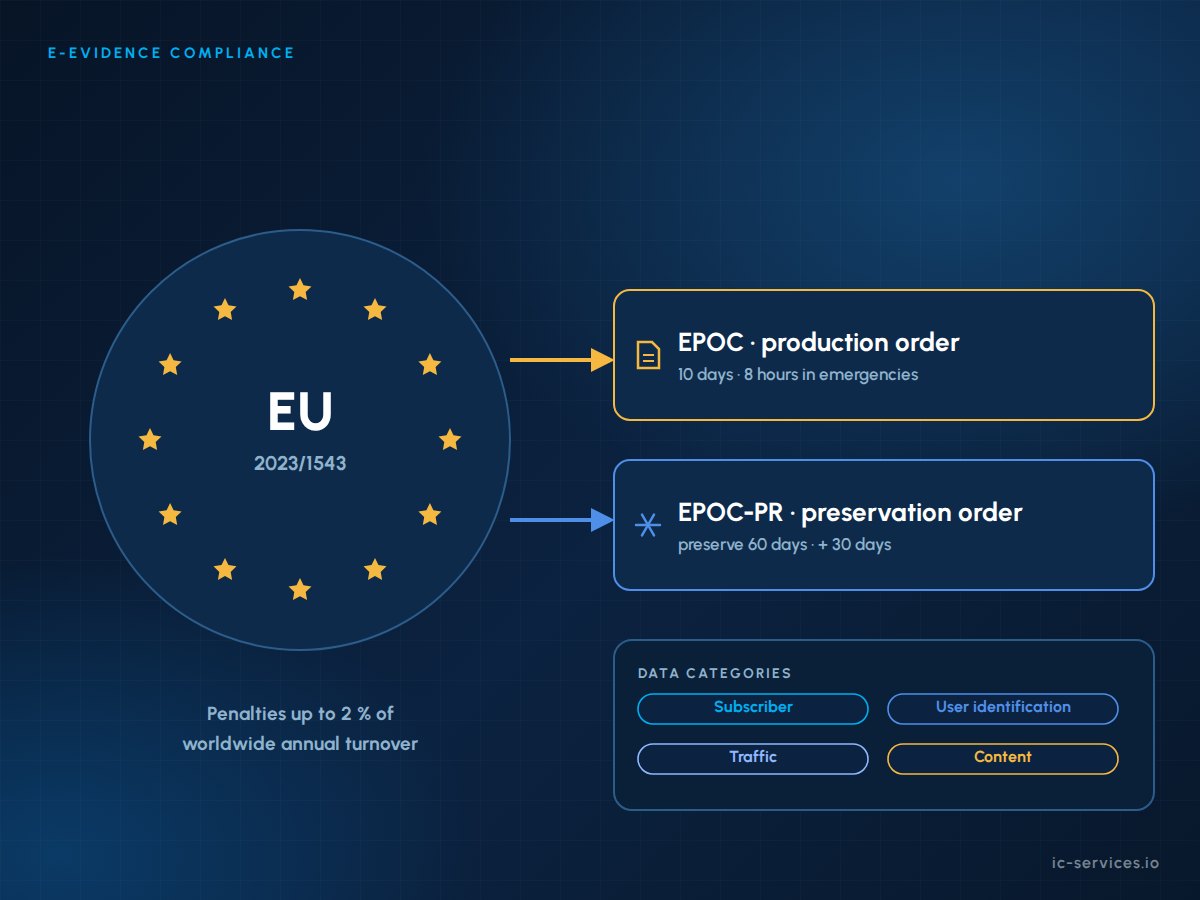
e-Evidence compliance is a provider’s ability to receive, assess and answer cross-border orders for electronic evidence under Regulation (EU) 2023/1543 and Directive (EU) 2023/1544. It combines an EU contact point, a secure exchange channel, data extraction and documented decisions. ICS delivers turnkey e-Evidence compliance for communication service providers, cloud platforms and digital service providers.
Key facts
- Legal framework: Regulation (EU) 2023/1543 and Directive (EU) 2023/1544, adopted on 12 July 2023.
- Dates: the Regulation has applied since 18 August 2026. The Directive had to be transposed by 18 February 2026.
- Deadlines: EPOC within 10 days, or 8 hours in emergencies. EPOC-PR preservation for 60 days, extendable by 30 days.
- Penalties: up to 2 % of total worldwide annual turnover (Art. 15 of the Regulation).
- Germany: the German Federal Ministry of Justice estimates that around 9,000 companies are affected.
- Contact point: notified to the competent authority, in Germany the Bundesamt für Justiz.
What does the e-Evidence Regulation require?
According to the European Commission, more than 85 % of criminal investigations rely on electronic evidence. Much of that data sits with providers in another Member State or outside the EU. Traditional mutual legal assistance often took too long.
The e-Evidence Regulation lets a judicial authority in one Member State address a provider in another Member State directly. The provider must preserve or produce the requested data within fixed deadlines. The accompanying Directive requires every provider to name an addressee for these orders.
In Germany, the implementing act (EBewMG) was published in the Federal Law Gazette on 12 March 2026. It enters into force in stages. For a plain-language introduction, see our guide What is e-Evidence?
Who is in scope of e-Evidence compliance?
The rules apply to providers that offer the following services in the EU:
- Electronic communication services, such as telephony, messaging and internet access
- Internet domain name and IP numbering services, such as IP address assignment and domain name services
- Other information society services that let users communicate or store data, such as social networks, online marketplaces and cloud services
The Regulation also covers companies established outside the EU if they offer services in the Union. Location of the data or the company headquarters does not change that.
Which orders and data categories apply?
Issuing authorities use two certificates. The European Production Order Certificate (EPOC) requests data. The European Preservation Order Certificate (EPOC-PR) requests that data is kept for a later production request.
| EPOC (production) | EPOC-PR (preservation) | |
|---|---|---|
| Purpose | Hand over existing data | Preserve data for a later request |
| Standard deadline | 10 days | Preserve for 60 days |
| Emergency or extension | 8 hours in emergencies | Extendable by 30 days |
| Data categories | Subscriber, identification, traffic and content data | Subscriber, identification, traffic and content data |
| Penalty for breaches | Up to 2 % of worldwide annual turnover | Up to 2 % of worldwide annual turnover |
The Regulation distinguishes four data categories:
- Subscriber data, such as name, address and contract details
- Data requested solely to identify the user, such as IP addresses and related identifiers
- Traffic data, such as time, duration and endpoints of a communication
- Content data, such as messages, files and other stored content
Who is the contact point for e-Evidence orders?
Providers established in the EU name a designated establishment. Providers without an EU establishment appoint a legal representative in a participating Member State. Both must be notified to the competent authority, in Germany the Bundesamt für Justiz.
The addressee must be able to receive and act on orders at any time. ICS can act as legal representative for non-EU providers and supports EU providers in running their designated establishment. Legal representative and designated establishment service
How ICS delivers e-Evidence compliance
01
Automated order processing
Incoming EPOC and EPOC-PR orders are registered, checked and routed automatically. Deadlines are tracked from the moment of receipt. Learn more
02
Legal representative support
ICS acts as legal representative for non-EU providers and helps EU providers set up their designated establishment. Learn more
03
Secure exchange
Orders and responses are exchanged via the decentralized IT system based on e-CODEX and, where applicable, other secure national channels.
04
Full audit trail and reporting
Every step, decision and data transfer is logged. Reports support internal oversight, authority questions and transparency duties.
05
Shared LI and retention architecture
The platform shares its architecture with the ICS lawful interception and data retention stack. Data sources and security controls are reused. Learn more
06
Managed operations
ICS can run e-Evidence operations around the clock as an extension of its Managed LI Operations.
Which challenges does e-Evidence compliance solve?
e-Evidence turns occasional legal requests into a time-critical operational process. ICS addresses four recurring challenges:
- Near-real-time workflows: an 8-hour emergency deadline leaves no room for manual hand-offs.
- 24/7 readiness: orders can arrive at night, on weekends and on public holidays.
- Secure integration: extraction must reach CRM, logs and storage systems without opening new attack paths.
- GDPR balance: providers must disclose exactly what an order requires and document why. Data minimization stays part of every response.

How are e-Evidence orders processed?
1
Receive
The order arrives via the decentralized IT system or a national channel and is registered with its deadline.
2
Validate
Formal requirements, issuing authority and jurisdiction are checked.
3
Assess
Complex cases are routed to your legal or compliance team for a decision.
4
Extract
The requested data categories are collected from the relevant systems.
5
Deliver
The response is reviewed and returned through the secure channel.
6
Document
Every step is stored in the audit trail for later review.
e-Evidence solutions for your organization
01
Telecom operators
Built on your existing LI architecture, with automated extraction from network and billing systems. e-Evidence for telcos
02
Enterprises and large platforms
API-first workflows, role-based approvals and high-volume processing for large order numbers. e-Evidence for enterprises
03
Non-EU providers
An EU contact point that receives and validates orders on your behalf. Legal representative service
04
Platform buyers
A ready platform for order management, extraction and audit. e-Evidence Compliance Platform
Why ICS
01
More than 20 years of experience
ICS has handled lawful interception and data disclosure for operators and authorities for more than two decades.
02
Proven in regulated environments
ICS holds multiple BNetzA acceptances for interception solutions. Our staff is security-cleared by the German Federal Ministry of the Interior.
03
One stack for all disclosure duties
Lawful interception, data retention and e-Evidence run on a shared architecture. That means one set of integrations and one audit approach.
04
Based in the EU
ICS is based in Cologne, Germany, inside a participating Member State. That makes it a practical EU contact point for non-EU providers.
Frequently Asked Questions
When does the e-Evidence Regulation apply?
Regulation (EU) 2023/1543 has applied since 18 August 2026. It was adopted on 12 July 2023 together with Directive (EU) 2023/1544. Member States had to transpose the Directive by 18 February 2026. In Germany, the implementing act (EBewMG) was published in the Federal Law Gazette on 12 March 2026 and enters into force in stages. Providers in scope must be able to handle orders now.
Which companies need e-Evidence compliance?
Providers of electronic communication services, domain name and IP numbering services, and other information society services that enable communication or storage are in scope. Examples include telecom operators, social networks, online marketplaces and cloud providers. Companies outside the EU are covered if they offer services in the Union. The German Federal Ministry of Justice estimates around 9,000 affected companies in Germany.
How fast must a provider respond to an EPOC?
A provider must hand over the requested data within 10 days of receiving a European Production Order Certificate. In emergencies, the deadline is 8 hours. For a European Preservation Order Certificate, the provider must keep the data for 60 days. The issuing authority can extend that period by 30 days. These deadlines require 24/7 readiness and a documented workflow.
What are the penalties for non-compliance?
Member States set the penalties for breaches of the Regulation. Under Art. 15, pecuniary penalties can reach up to 2 % of the provider’s total worldwide annual turnover in the preceding financial year. Penalties must be effective, proportionate and dissuasive. A documented, auditable process is therefore important. It shows authorities how each order was received, assessed and answered.
What is the difference between a designated establishment and a legal representative?
Both are addressees for e-Evidence orders. A provider established in the EU names one of its establishments as designated establishment. A provider without an EU establishment appoints a legal representative in a participating Member State. In both cases, the contact point must be notified to the competent authority. In Germany, that authority is the Bundesamt für Justiz.
How are e-Evidence orders transmitted?
Orders and responses are exchanged via a decentralized IT system based on e-CODEX. It connects competent authorities and providers through interoperable access points. Where applicable, other secure national channels can also be used. The ICS e-Evidence Compliance Platform supports both routes. It registers every incoming order, tracks its deadline and logs each response in the audit trail.
Is your e-Evidence process ready for the next order?
The Regulation already applies. We review your current setup and show what a compliant, auditable workflow looks like for your services.