
EU CONTACT POINT
Legal Representative e-Evidence Service and Designated Establishment Support
Every provider offering services in the EU needs an addressee for e-Evidence orders. ICS acts as legal representative for non-EU providers and helps EU providers run their designated establishment.
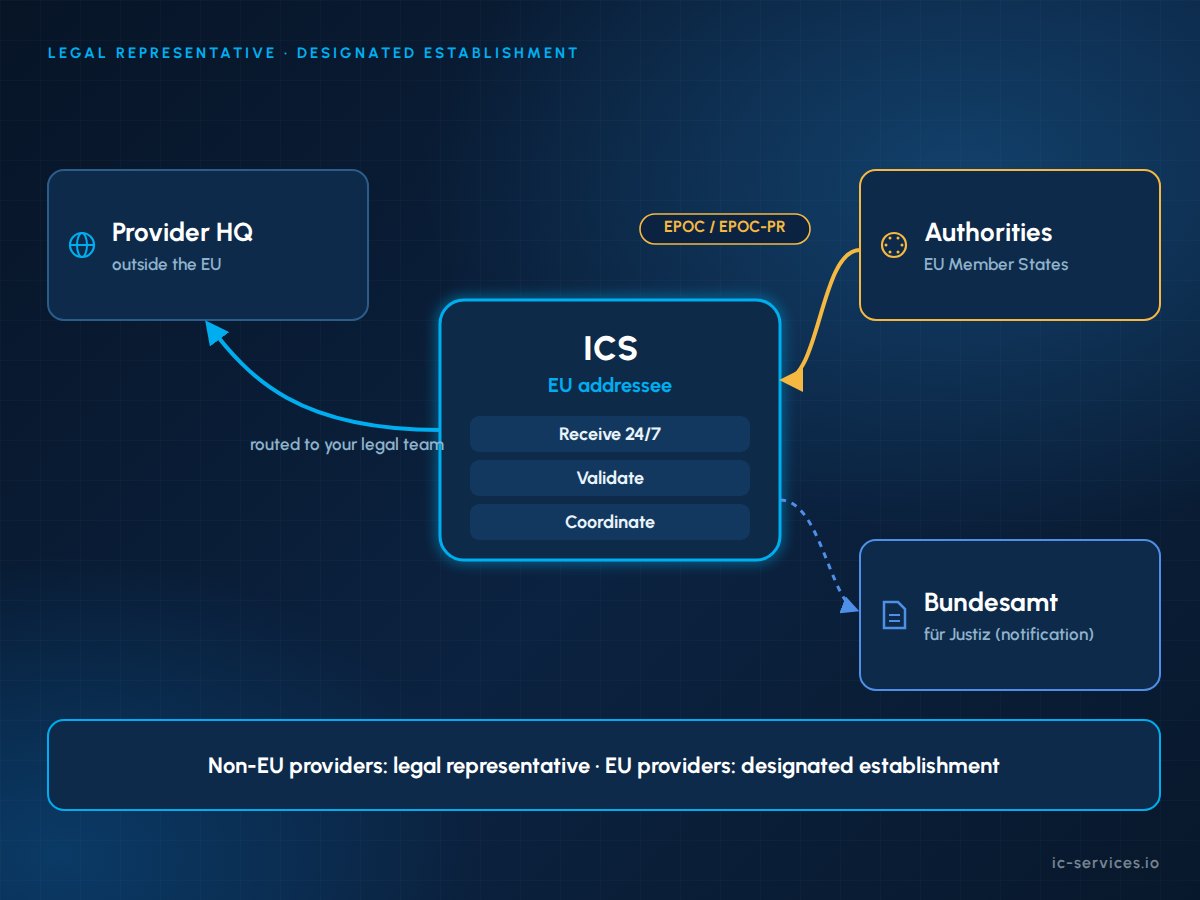
A legal representative e-Evidence service is a third party that receives European production and preservation orders for a non-EU provider. Directive (EU) 2023/1544 requires this addressee in a participating Member State. Providers established in the EU name one of their own establishments instead, the designated establishment.
Key facts
- Legal basis: Directive (EU) 2023/1544 requires an addressee for providers offering services in the EU.
- Non-EU providers: appoint a legal representative in a participating Member State.
- EU providers: designate an establishment as their addressee.
- Notification: the addressee is notified to the competent authority, in Germany the Bundesamt für Justiz.
- Liability: both the provider and its addressee can be held liable.
- Timing: the e-Evidence Regulation (EU) 2023/1543 has applied since 18 August 2026.
What is the difference between a legal representative and a designated establishment?
Both roles serve the same purpose. They give authorities a reliable EU address for European Production Order Certificates (EPOC) and European Preservation Order Certificates (EPOC-PR). The difference lies in where the provider is established.
| Aspect | Designated establishment | Legal representative |
|---|---|---|
| Who needs it | Providers established in the EU | Providers not established in the EU |
| What it is | One of the provider’s own EU establishments | A natural or legal person appointed by the provider |
| Location | A participating Member State | A participating Member State |
| Notification | To the competent authority of that Member State | To the competent authority of that Member State |
| Authority in Germany | Bundesamt für Justiz | Bundesamt für Justiz |
| Liability | Provider and addressee can be held liable | Provider and addressee can be held liable |
| ICS role | Setup and operational support | Acting as legal representative |
For the full legal text, see Directive (EU) 2023/1544 on EUR-Lex.
What must an e-Evidence addressee be able to do?
The Directive sets clear expectations for every addressee. A designated establishment or legal representative must:
- be notified to the competent authority, including its contact details
- receive orders from authorities at any time
- comply with those orders and enforce them within the provider’s organization
- have the necessary powers and resources to cooperate with authorities
A legal representative e-Evidence service must meet all of these points. A mailbox alone is not enough, because the 8-hour emergency deadline leaves no time for delays.
Who needs a legal representative e-Evidence service?
Any provider without an EU establishment that offers services in the Union needs a legal representative.
01
Non-EU SaaS providers
Software and collaboration providers that let EU users communicate or store data. SaaS and cloud platforms
02
Global cloud providers
Cloud and hosting providers headquartered outside the EU with customers in the Union.
03
Non-EU telcos
MVNOs and transit carriers that serve EU customers without an EU establishment. e-Evidence for telcos
04
International marketplaces
Online marketplaces and platforms that enable communication between EU users and sellers.
What if you are established in the EU?
EU-established providers designate one of their own establishments. They do not need a legal representative e-Evidence service, but they face the same operational demands. Many lack the internal resources to run their establishment around the clock. ICS supports these companies in setting up and operating it.
Support covers notification, order reception, initial validation and documentation. Your designated establishment stays in your organization, while ICS handles the operational load. e-Evidence compliance overview
What ICS provides as your EU contact point
01
Notification and registration
ICS supports the notification to the competent authority and keeps the registration up to date when details change.
02
24/7 order reception
EPOC and EPOC-PR orders are received around the clock via the decentralized IT system and national channels.
03
Initial validation
Each order is checked for jurisdiction and formal requirements before it goes further.
04
Secure routing
Validated orders are routed securely to your legal or compliance team, with deadlines attached.
05
Authority coordination and objections
ICS coordinates with authorities and supports you if you raise an objection or rely on grounds for refusal.
06
Documentation and audit trail
Every order, check and communication is logged, so you can show how each case was handled.
How does the legal representative e-Evidence service work?
1
Scoping
We clarify where you are established, which services you offer in the EU and which addressee you need.
2
Appointment and notification
ICS is appointed or your establishment is set up, and the competent authority is notified.
3
Integration
We agree routing, contacts and escalation paths with your legal and compliance team.
4
Reception and validation
Incoming orders are received 24/7 and checked for jurisdiction and formal requirements.
5
Decision and response
Your team decides on complex cases, and the response is returned through the secure channel.
6
Documentation
Each step is recorded in the audit trail for authorities and internal review.
How does the service connect to the e-Evidence platform?
The service can run on its own or together with the ICS e-Evidence Compliance Platform. Combined, they form an end-to-end pipeline from order reception to data delivery.
- Reception: orders arrive at the ICS contact point.
- Workflow: the platform tracks deadlines, approvals and objections.
- Extraction: data is collected from your systems according to the requested categories.
- Audit: one audit trail covers the whole process.
This avoids hand-offs between separate tools and keeps every decision traceable.

Who remains responsible for compliance?
The provider remains responsible for compliance, even when ICS acts as its addressee. Both the provider and its designated establishment or legal representative can be held liable. Under the Regulation, penalties can reach up to 2 % of total worldwide annual turnover.
Why ICS
01
Based in Germany
ICS is based in Cologne, inside a participating Member State. Orders can be addressed to us in the EU.
02
More than 20 years of experience
ICS has worked with operators, law enforcement agencies and regulators for more than two decades.
03
Security-cleared staff
Our team is security-cleared by the German Federal Ministry of the Interior and may handle classified information.
04
From contact point to data delivery
Our legal representative e-Evidence service connects directly to the ICS e-Evidence Compliance Platform and the wider ICS disclosure stack.
Frequently Asked Questions
Who needs a legal representative for e-Evidence?
Providers that offer services in the EU but are not established there need a legal representative. Examples include non-EU SaaS providers, global cloud providers, international marketplaces and non-EU telcos such as MVNOs and transit carriers. The legal representative must be located in a participating Member State. It must also be notified to the competent authority, which in Germany is the Bundesamt für Justiz.
What is a designated establishment?
A designated establishment is the addressee that an EU-established provider names for e-Evidence orders. It is one of the provider’s own establishments in a participating Member State. Like a legal representative, it must be notified to the competent authority and able to receive and act on orders. ICS helps EU providers set it up and operate it when internal resources are limited.
Can ICS act as our legal representative?
Yes. ICS offers a legal representative e-Evidence service for providers that are not established in the EU. ICS supports the notification, receives EPOC and EPOC-PR orders 24/7 and performs an initial validation. Validated orders are routed securely to your legal or compliance team. ICS also coordinates with authorities and documents each step in an audit trail.
Is the provider still liable if ICS is the legal representative?
Yes. Appointing a legal representative does not transfer the provider’s obligations. The provider remains responsible for compliance with the e-Evidence rules. Both the provider and its addressee can be held liable. Penalties under the Regulation can reach up to 2 % of total worldwide annual turnover. Clear routing, fast decisions and complete documentation therefore matter on both sides.
Where must the addressee be notified in Germany?
In Germany, the competent authority is the Bundesamt für Justiz, the Federal Office of Justice. Providers must notify their designated establishment or legal representative, including contact details, and keep that information current. ICS supports the initial notification and later updates. In other participating Member States, the notification goes to the authority each Member State has named.
How are orders delivered to the legal representative?
Orders are delivered via the decentralized IT system based on e-CODEX and, where applicable, through other secure national channels. ICS receives orders on both routes around the clock. Each order is registered, checked for jurisdiction and formal requirements, and forwarded to your team with its deadline. With the e-Evidence Compliance Platform, the same process continues through extraction and delivery.
Need an EU contact point for e-Evidence orders?
Tell us where you are established and which services you offer in the EU. We explain which addressee you need and how ICS can support you.