
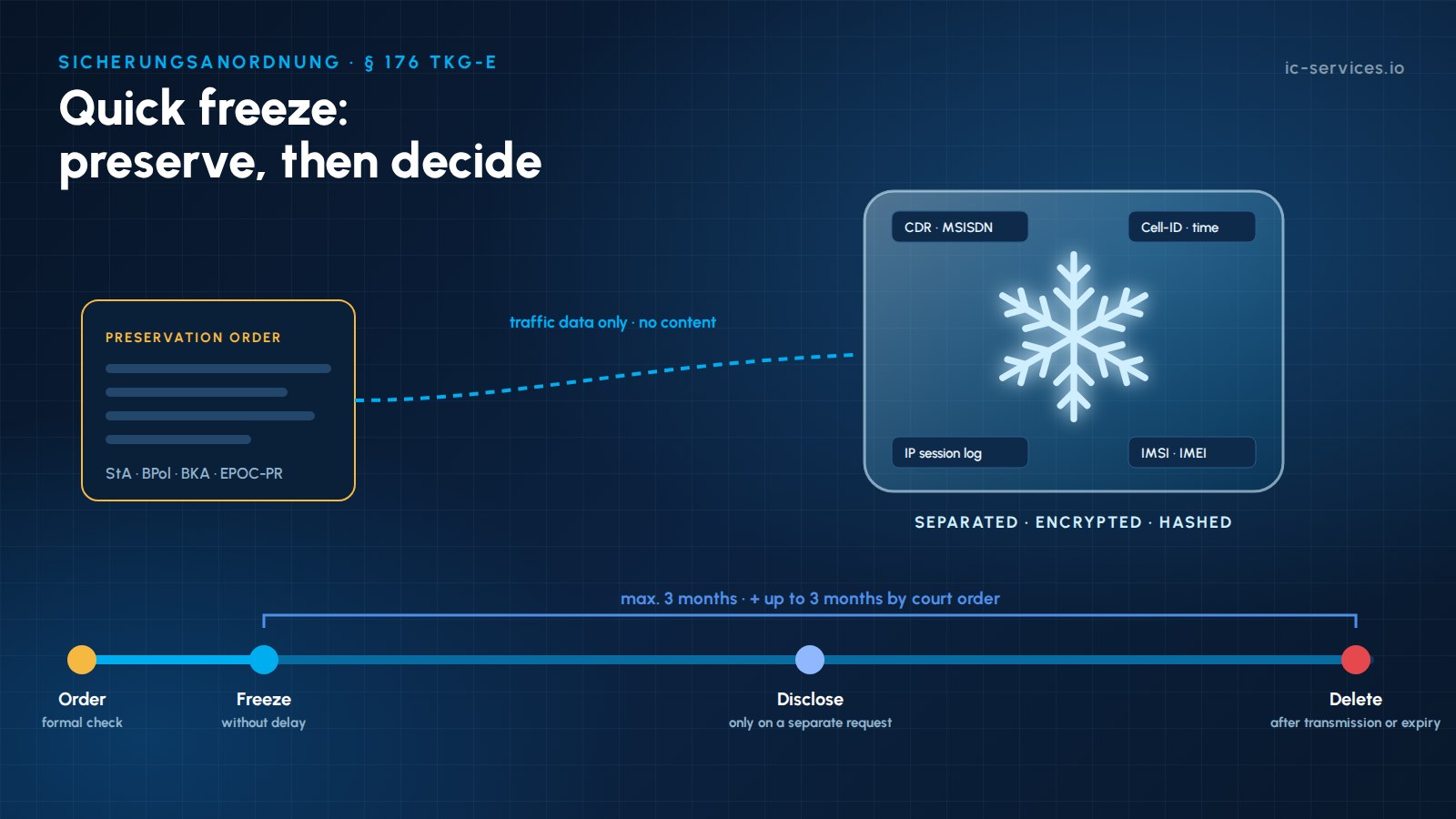
Быстрая заморозка is coming to Germany. With the government bill on IP address retention and the further development of investigative powers in criminal proceedings (Bundestag printed paper 21/6581), Germany is introducing a Sicherungsanordnung: an order that obliges telecommunications providers to preserve existing traffic data immediately, before a court decides whether the data may be disclosed.
For providers, this means a new, time-critical process: receive the order, freeze the data, store it separately and securely, watch the deadlines, disclose it only on a second order, and delete it irreversibly. This article explains what the draft requires, who is affected and how to prepare.
Status: This article reflects the government draft as introduced in the Bundestag (first reading on 24 June 2026, now in committee). Details may still change.
Основные выводы
- A Sicherungsanordnung freezes traffic data only, including location and cell data. Content, subscriber data and data from the new IP address retention are out of scope.
- Orders can come from the public prosecutor (in urgent cases from investigators), the Federal Police и BKA. They are valid for up to three months and can be extended by a court by up to three months.
- Around 3,000 providers of publicly available telecommunications services, and those who participate in providing them, are affected under § 176 TKG-E.
- Preservation and disclosure are two separate steps. Data is only handed over on a separate request, typically based on a court order.
- Frozen data must be stored separately, protected by state-of-the-art security measures, and deleted irreversibly after transmission or expiry.
- Сайт Европейский охранный ордер (EPOC-PR) under the e-Evidence Regulation runs in parallel and is expected to be even more relevant in practice.
What Is Quick Freeze?
Quick freeze is the targeted alternative to general data retention. Instead of storing everyone’s traffic data in advance, authorities can order a provider to “freeze” data that already exists about specific persons or locations, as soon as there is a concrete reason. The data is kept from being deleted in routine processes, and the authorities then have time to obtain a court order for disclosure.
| Quick freeze (§ 176 TKG-E) | IP address retention (§ 177 TKG-E) | |
|---|---|---|
| Триггер | Индивидуальный заказ | No trigger, applies to all connections |
| Стороны, на которых возлагаются обязательства | All public telecom services and those who participate (approx. 3,000) | Internet access providers only (approx. 700) |
| Данные | Данные о трафике, включая данные о местоположении и сотовой связи, без учета контента | Public IP, ports, line and user ID, timestamps |
| Продолжительность | До 3 месяцев, плюс до 3 месяцев по решению суда | 3 months per assignment |
| Раскрытие информации | Only on a separate request (§ 175 TKG-E, § 100g StPO) | Only for subscriber identification (§ 174 TKG) and e-Evidence |
We cover the second instrument in detail in our next article on IP address retention.
Legal Basis and Who Can Order a Freeze
- § 100g (7) StPO-E (criminal prosecution): ordered by the public prosecutor, and in urgent cases by its investigators (police, customs investigation). Maximum three months, with a court-ordered extension of up to three more months on application of the prosecutor.
- § 25a BPolG-E (Federal Police, threat prevention): written order by the President of the Federal Police Headquarters or the head of a directorate, maximum three months, extendable by a court by up to three months at a time.
- BKAG: corresponding powers for the Federal Criminal Police Office.
- Federal states: the Bundesrat has asked for preservation powers for state police as well. This is still open in the committee.
- § 176 TKG-E gives providers the authority to process the data. It addresses anyone who “provides publicly available telecommunications services or participates in providing them“, so service providers acting on a provider’s behalf are covered directly.
Which Data Is Covered?
In scope (traffic data under § 3 No. 70 TKG):
- Connection data: calling and called numbers, IMSI, IMEI, timestamps, duration, service type (voice, SMS, data)
- Location data, including cell IDs. An order can also cover entire radio cells if it describes them narrowly in space and time.
- Internet session data: assigned IP address, ports, start and end, volume
Out of scope:
- Content of communications (message text, call content)
- Data from the new IP address retention under § 177 TKG-E
- Usage data of digital services (covered by a separate provision)
- Subscriber data, which is requested through regular information requests, not frozen
The freeze covers data that exists at the time of the order and, in the prevailing reading, data that arises until the deadline. Providers do not have to create data that their systems do not generate. Whether a freeze really extends to future data is still debated, but the wording (“to preserve without delay”) suggests freezing the existing data and continuing to add new data until the deadline.
Provider Obligations Step by Step
1. Receive the Order and Check It Formally
- Accept the order in writing. Electronic channels (ETSI-ESB / E-Mail-ESB) are expected in the TR TKÜV, with details still open.
- Check the formal requirements: authorised authority, legal basis, identifier or cell description, data types, period, end date, duration of no more than three months.
- There is no substantive legality review. That responsibility lies with the authority.
- Ask the authority if identifiers or cell descriptions are unclear.
2. Freeze the Data
- Without delay and completely, extract the relevant records from mediation and CDR systems, HLR/HSS logs, packet gateway (PGW/UPF) session logs, RADIUS/Diameter accounting and location logs.
- Suspend the routine deletion of these records, which normally happens after a few days or weeks.
- Store them separately from all other subscriber data on a secured and reliable system.
- Apply state-of-the-art technical and organisational measures: encryption, access control, four-eyes principle and logging.
- Keep the data ready for immediate transmission.
3. Manage the Freeze
- Monitor the deadline and wait for any court extension. Without an extension, the data is deleted when the order expires.
- Keep the order confidential. Informing the subscriber or third parties is an administrative offence.
- Log all access under § 35 TKÜV, which will also cover the new legal bases on which data is stored.
4. Disclose Only on a Separate Request
Disclosure is not automatic. It requires a separate request, typically a court order under § 100g (1) to (4) StPO or § 25 BPolG. The usual rules then apply: formal check by qualified staff or automatically, secured transmission, and the ETSI-ESB obligation for providers with 100,000 or more contract partners. For European orders, disclosure follows a European Production Order.
5. Delete Irreversibly
- Delete the data without delay and irreversibly after transmission, or when the order expires.
- Document the deletion. Failure to delete is subject to fines.
- For European preservation orders: delete once preservation is no longer required under Regulation (EU) 2023/1543.
6. Inform the Regulator and Meet the Deadlines
- Once the service starts, inform the BNetzA how the requirements are implemented, and report any changes without delay.
- On request, tell the BNetzA who stores the frozen data. This is where an external service provider is named.
- The BNetzA plans regular checks.
- Timeline: the obligation applies once the law enters into force. Technical details will follow in the TKÜV and TR TKÜV, with the transition periods of § 170 (8) TKG (one year, and three years for existing systems).
Compensation (JVEG, New Annex 3)
| Item | Amount |
|---|---|
| Freeze per identifier (incl. location data) | EUR 25 |
| Freeze per radio cell / each further cell | EUR 40 / + EUR 5 |
| Freeze by address / area / route (per 10 km started) | EUR 75 / EUR 190 / EUR 65 |
| Last known location | EUR 85 |
| Per extension | EUR 25 |
| Per disclosure after a freeze | EUR 20 |
Amounts are reduced by 20 % when billed through central contact points. The explanatory memorandum expects only about 600 to 1,100 national orders per year. For most providers, readiness matters more than volume.
Practical Challenges
- “Without delay” means 24/7 readiness. Automating extraction and freezing is the only realistic way to comply.
- MVNOs depend on their host network. Cell, location and data session logs usually sit with the host MNO. Without a contractual data supply, an MVNO cannot comply with cell-based orders, so this must be clarified in the wholesale agreement. See MVNO vs MNO responsibilities.
- Security level of the storage must match what the TKÜV and TR TKÜV will require. Designing to today’s BNetzA and BSI standards avoids costly rework later.
- Защита данных: an external service provider needs a data processing agreement (Art. 28 GDPR), and its staff must be bound by telecommunications secrecy.
- Parallel e-Evidence orders: European Preservation Orders under Article 6 of Regulation (EU) 2023/1543 must be handled with the same rigour. See our e-Evidence solutions.
How ICS Helps: Quick Freeze as a Managed Service
ICS International Carrier Services имеет более 20 лет опыта работы в сфере телекоммуникаций, законного прослушивания и обеспечения соблюдения нормативных требований и содержит multiple BNetzA acceptances. Because § 176 TKG-E explicitly covers those who participate in providing telecommunications services, ICS can act as your service provider for the complete freeze process. You remain the obligated party, and ICS is named to the BNetzA as the entity that stores the data.
- Объем поступивших заказов: via the existing written channels, and via ESB / E-Mail-ESB once the TR TKÜV defines them, with formal check, queries to the authority, deadline calendar and extension management.
- Data extraction: connectors to your mediation/CDR systems, PGW/UPF logs and RADIUS/Diameter accounting, with a snapshot of existing data and continued collection until the deadline.
- Secured freeze vault: one encrypted container per order, hash-based integrity evidence and four-eyes access.
- Раскрытие информации on a separate request via ESB, with a handover record.
- Automated, logged, irreversible deletion, with a deletion certificate for you.
- BNetzA documentation: implementation documents, change notifications and audit support.
- JVEG billing for all freeze and disclosure items, combined with our Платформа для обеспечения соответствия стандартам e-Evidence for European orders.
Узнайте больше о наших data retention and quick freeze services. Prepare now instead of scrambling when the law takes effect. Связаться с ICS for a readiness assessment.
Часто задаваемые вопросы
Что такое быстрая заморозка?
Quick freeze is a procedure in which authorities order a telecommunications provider to preserve existing traffic data about specific persons or locations without delay. The data may only be disclosed later, on a separate legal basis, and must otherwise be deleted.
How long must frozen data be kept?
Under the German draft, a preservation order is valid for up to three months. A court can extend it by up to three months. After transmission or expiry, the data must be deleted irreversibly.
Does a Sicherungsanordnung cover content or IP retention data?
No. It covers traffic data, including location and cell data, but not the content of communications, subscriber data, usage data of digital services or data stored under the new IP address retention.
Who is obligated to implement quick freeze orders?
All providers of publicly available telecommunications services and those who participate in providing them, which is around 3,000 companies according to the draft. External service providers acting on behalf of a provider are covered as well.
How does quick freeze relate to the EU e-Evidence Regulation?
The e-Evidence Regulation introduces a European Preservation Order (EPOC-PR) with a similar purpose. Under Article 6(2) of the Regulation, German authorities can only issue a European Preservation Order if a comparable domestic order exists. The Sicherungsanordnung provides it, and providers will have to handle both types of order.
Disclaimer: This article provides general information based on the German government draft (BT-Drs. 21/6581) as of September 2026. It does not constitute legal advice. Provisions, deadlines and technical details may change during the parliamentary process and in the TKÜV / TR TKÜV.
Похожие статьи
- MVNO vs MNO: кто несет юридическую ответственность за законный перехват?
- Что такое электронное доказательство? Полное руководство
- LI Compliance как услуга: Какие SLA следует требовать на самом деле?