
LI APPLIANCE
PSTN/ISDN to SIP Converter for Lawful Interception
Keep intercepting while your network moves to IP voice. The converter bridges legacy PSTN and ISDN to SIP, so interception follows ETSI TS 102 232-5.
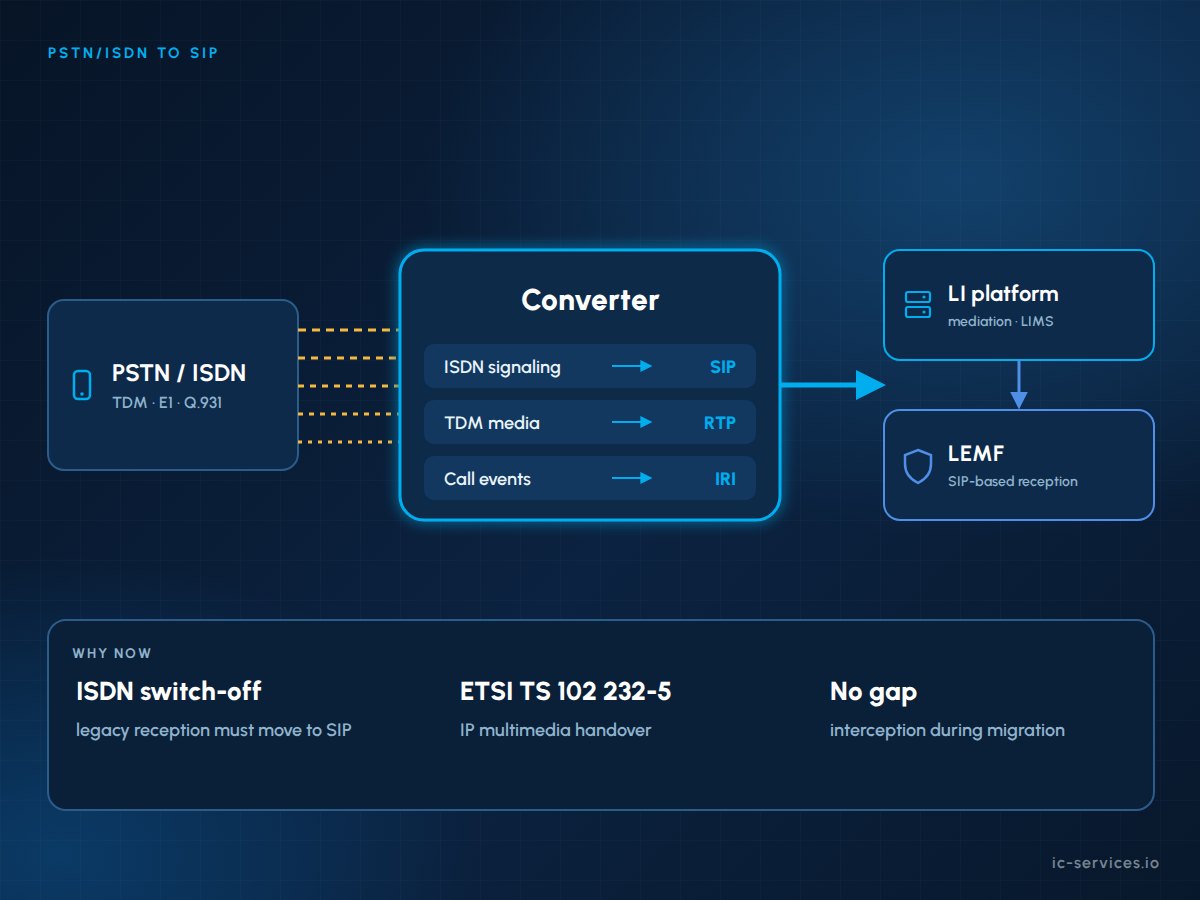
A PSTN/ISDN to SIP converter is an appliance that bridges legacy circuit-switched PSTN and ISDN connections to SIP. The ICS converter turns signaling and media into SIP, so LI platforms can intercept these calls as VoIP per ETSI TS 102 232-5. Operators and agencies can keep intercepting while networks move to IP voice.
עובדות עיקריות
- Bridge: connects legacy circuit-switched PSTN/ISDN to SIP.
- סטנדרטי: enables interception of VoIP services per ETSI TS 102 232-5.
- המרה: transforms both signaling and media into SIP.
- Continuity: interception keeps working throughout the migration to IP voice.
- Two audiences: network operators and law enforcement agencies.
- Complete chain: complementary ICS software and hardware from TDM access to SIP handover.
Why does the ISDN shutdown matter for lawful interception?
Operators are replacing PSTN and ISDN with all-IP networks. During this change, legacy circuits and new SIP services often run side by side. Interception obligations apply to both, and there must be no gap on the day a service moves.
The shutdown affects two sides of the interception chain:
- Operators need a consistent way to intercept calls that still arrive over TDM while new services already use SIP.
- רשויות אכיפת החוק often receive intercepted calls through ISDN-based reception. When ISDN is switched off, that reception must move to SIP.
A PSTN/ISDN to SIP converter solves both problems. It turns legacy calls into SIP sessions, so a single IP-based interception chain can handle them.
What does the PSTN/ISDN to SIP converter do?
The converter sits between the circuit-switched world and your IP-based interception platform. It handles two conversion tasks.
- Signaling conversion: circuit-switched call control is translated into SIP messages, so each call becomes a SIP session.
- Media conversion: voice carried on TDM channels is transformed into IP media streams that belong to the same session.
The resulting SIP sessions look like native VoIP calls to the interception platform. The platform can capture them and deliver them to the authority per ETSI TS 102 232-5, the ETSI handover specification for IP multimedia services. This lets operators keep one interception approach for legacy and IP voice.
How does the conversion work?
A typical interception flow through the converter has six stages.
1
Connect
The converter is attached to the relevant PSTN/ISDN interface.
2
Translate signaling
Call setup, progress and release are mapped to SIP.
3
Convert media
TDM voice is converted into IP media streams linked to the SIP session.
4
Capture
The LI platform intercepts the SIP sessions of targets named in a valid legal order.
5
Hand over
Intercept-related information and call content are delivered per ETSI TS 102 232-5.
6
Verify
End-to-end call interception tests confirm that the defined call scenarios reach the monitoring facility correctly.
Legacy chain vs SIP-based chain
The table compares a traditional circuit-switched interception chain with a SIP-based chain that uses the converter.
| היבט | Legacy circuit-switched chain | SIP-based chain with ICS converter |
|---|---|---|
| Access | PSTN/ISDN circuits | PSTN/ISDN circuits converted to SIP, plus native SIP |
| Signaling | Circuit-switched call control | SIP |
| Media | TDM voice channels | IP media streams |
| Handover specification | ETSI TS 101 671 (circuit-switched) | ETSI TS 102 232-5 (IP multimedia) |
| Agency reception | Often ISDN-based | SIP and IP-based |
| Outlook | Ends with the ISDN switch-off | Continues on all-IP networks |
| Interception platforms | Separate legacy components | One IP-based chain for legacy and VoIP |
For background on the interfaces involved, see our guide to HI1, HI2 ו-HI3 and our article on the פונקציית תיווך.
What should you plan before the switch-off?
A smooth transition starts well before the last ISDN line goes dark. ICS recommends clarifying these points early:
- היקף: which legacy interfaces and services are still subject to interception orders.
- Placement: where the converter sits between TDM access and the LI platform.
- Interfaces: how the converter, mediation platform and authority connect, and which handover specification applies.
- Parallel operation: how long legacy and IP voice will run side by side.
- Agency coordination: when the receiving side moves from ISDN to SIP.
- Test plan: which call scenarios must pass before switch-over.
Who needs a PSTN/ISDN to SIP converter?
01
Operators migrating to all-IP
Fixed-line operators that retire PSTN and ISDN can keep interception running at every stage of the migration.
02
Operators with mixed networks
Where TDM access and SIP services run in parallel, the converter brings legacy calls into the same IP-based interception chain.
03
רשויות אכיפת החוק
Agencies with ISDN-based reception need a path to SIP before ISDN disappears. The converter supports that move on the receiving side.
Services around the converter
ICS delivers more than the appliance.
01
Migration consulting
ICS helps define the migration path, the placement of the converter and the interfaces between TDM access, LI platform and authority.
02
Deployment and integration
The team installs the converter and integrates it with your mediation platform and existing LI systems.
03
End-to-end testing
ICS runs end-to-end call interception tests, so you know that the defined call scenarios reach the monitoring facility correctly before switch-over.
04
Complementary LI components
ICS software and hardware complete the chain, from TDM access to SIP handover, including the פלטפורמת הגישור LI ו- מערכת ניהול.
מדוע ICS
01
ניסיון של יותר מ-20 שנים
ICS has worked in telecommunications, lawful interception and compliance for more than two decades, across legacy and IP networks.
02
אישורים מרובים מטעם ה-BNetzA
פתרונות היירוט של ICS עברו מספר הליכי קבלה אצל הסוכנות הפדרלית הגרמנית לתקשורת.
03
עובדים בעלי סיווג ביטחוני
צוותנו קיבל אישור ביטחוני ממשרד הפנים הפדרלי הגרמני, והוא רשאי לטפל במידע מסווג.
שאלות נפוצות
What is a PSTN/ISDN to SIP converter?
A PSTN/ISDN to SIP converter is an appliance that connects legacy circuit-switched telephone networks to SIP. In lawful interception, it converts signaling and media from PSTN and ISDN calls into SIP sessions. Interception platforms can then capture these calls like VoIP and deliver them to authorities per ETSI TS 102 232-5, the ETSI specification for IP multimedia handover.
Why does the ISDN shutdown affect lawful interception?
When operators replace ISDN with all-IP networks, interception must continue without a gap. Legacy and IP voice often run in parallel for some time, and both are subject to interception orders. Law enforcement agencies that receive intercepted calls over ISDN must also move their reception to SIP. A converter lets both sides use one IP-based chain.
Which standard applies to the SIP-based handover?
ETSI TS 102 232-5 defines the handover of intercepted IP multimedia services, including SIP-based voice. It belongs to the ETSI TS 102 232 family for IP handover. Legacy circuit-switched interception is typically based on ETSI TS 101 671. The ICS converter enables the move from the circuit-switched model to TS 102 232-5.
Is the converter only for network operators?
No. Operators use it to keep interception running while they migrate PSTN and ISDN to IP voice. Law enforcement agencies can also benefit, because many still run ISDN-based reception that must move to SIP when ISDN is switched off. ICS advises both sides on the right migration path and placement of the converter.
Does ICS test the interception chain after installation?
Yes. ICS runs end-to-end call interception tests after deployment. The tests confirm that calls converted from PSTN or ISDN are captured, mediated and delivered correctly to the monitoring facility. ICS also integrates the converter with your mediation platform and existing LI systems, so the complete chain is verified before you rely on it.
Planning your ISDN switch-off?
Talk to ICS about the migration path for your interception chain, from TDM access to SIP handover.