
LI APPLIANCE
Conversor de PSTN/ISDN para SIP para interceção legal
Continue a efetuar a interceção enquanto a sua rede migra para a voz sobre IP. O conversor faz a ponte entre as redes PSTN e ISDN tradicionais e o protocolo SIP, pelo que a interceção cumpre a norma ETSI TS 102 232-5.
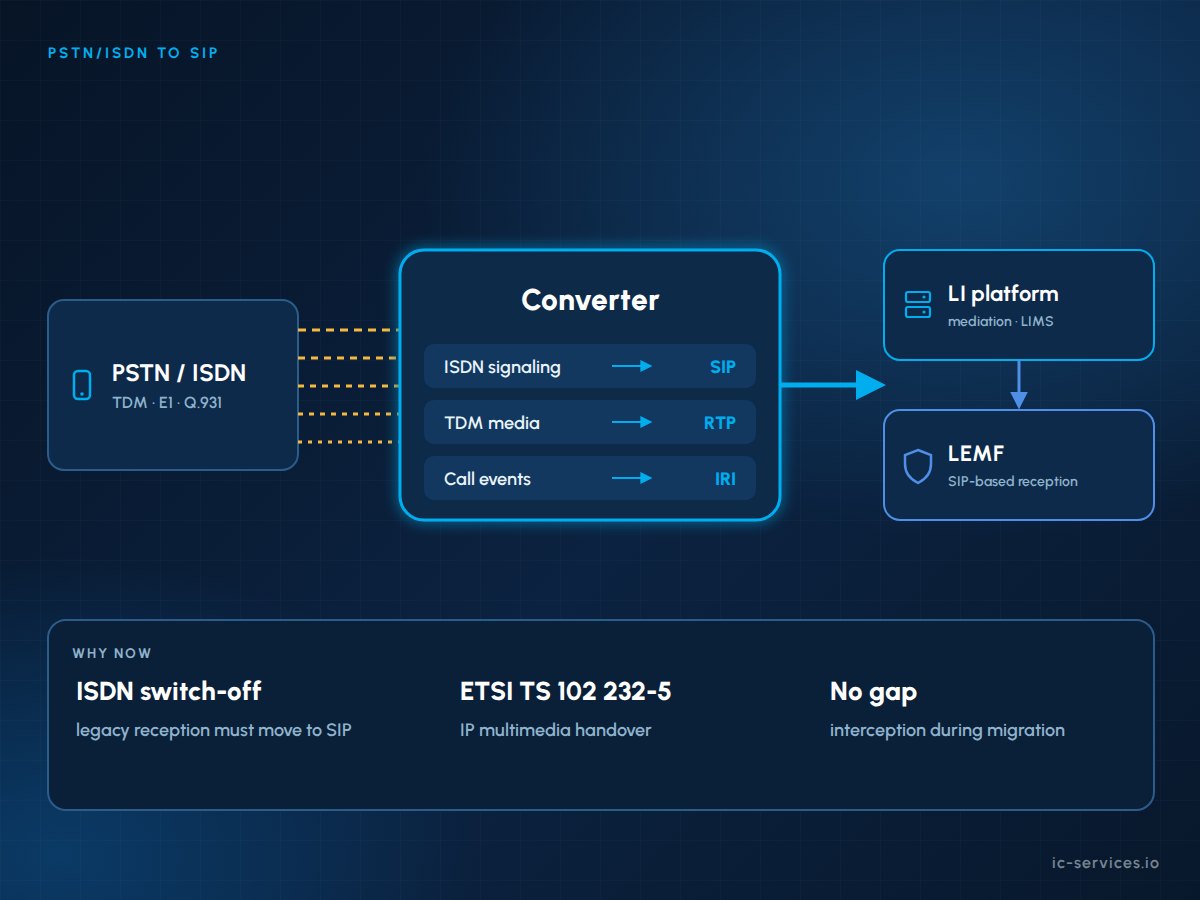
Um conversor de PSTN/ISDN para SIP é um dispositivo que faz a ponte entre as ligações PSTN e ISDN tradicionais, com comutação de circuitos, e o protocolo SIP. O conversor ICS converte a sinalização e os dados multimédia para o protocolo SIP, para que as plataformas LI possam interceptar estas chamadas como VoIP, de acordo com a norma ETSI TS 102 232-5. As operadoras e as agências podem continuar a interceptar as chamadas enquanto as redes migram para a voz sobre IP.
Factos essenciais
- Ponte: liga as redes PSTN/ISDN tradicionais, com comutação de circuitos, ao protocolo SIP.
- Padrão: permite a interceção de serviços VoIP de acordo com a norma ETSI TS 102 232-5.
- Conversão: transforma tanto a sinalização como os dados multimédia em SIP.
- Continuidade: a interceção continua a funcionar durante toda a migração para a voz sobre IP.
- Dois públicos: operadores de rede e autoridades responsáveis pela aplicação da lei.
- Cadeia completa: software e hardware ICS complementares, desde o acesso TDM até à transição para SIP.
Por que razão o encerramento da rede ISDN é importante para a interceção legal?
As operadoras estão a substituir as redes PSTN e ISDN por redes totalmente IP. Durante esta transição, os circuitos antigos e os novos serviços SIP funcionam frequentemente em paralelo. As obrigações de interceção aplicam-se a ambos, e não pode haver qualquer interrupção no dia em que o serviço for transferido.
A interrupção afeta duas etapas da cadeia de interceção:
- Operadores É necessária uma forma consistente de interceptar as chamadas que ainda chegam através do TDM, enquanto os novos serviços já utilizam o SIP.
- Autoridades responsáveis pela aplicação da lei recebem frequentemente chamadas interceptadas através de uma receção baseada em ISDN. Quando o ISDN está desligado, essa receção tem de passar para o SIP.
Um conversor de PSTN/ISDN para SIP resolve ambos os problemas. Transforma as chamadas tradicionais em sessões SIP, para que uma única cadeia de interceção baseada em IP possa tratá-las.
O que faz o conversor de PSTN/ISDN para SIP?
O conversor situa-se entre o mundo da comutação de circuitos e a sua plataforma de interceção baseada em IP. Este realiza duas tarefas de conversão.
- Conversão de sinalização: o controlo das chamadas com comutação de circuitos é convertido em mensagens SIP, pelo que cada chamada se torna uma sessão SIP.
- Conversão de formatos multimédia: a voz transmitida através de canais TDM é transformada em fluxos de multimédia IP que pertencem à mesma sessão.
As sessões SIP resultantes parecem chamadas VoIP nativas para a plataforma de interceção. A plataforma pode capturá-las e transmiti-las à autoridade, em conformidade com a norma ETSI TS 102 232-5, a especificação de transferência do ETSI para serviços multimédia IP. Isto permite que os operadores mantenham uma única abordagem de interceção tanto para a voz tradicional como para a voz IP.
Como funciona a conversão?
Um fluxo típico de interceção através do conversor tem seis fases.
1
Ligar-se
O conversor está ligado à interface PSTN/ISDN correspondente.
2
Traduzir a sinalização
O estabelecimento, o andamento e o encerramento da chamada estão mapeados para o SIP.
3
Converter ficheiros multimédia
A voz TDM é convertida em fluxos de multimédia IP associados à sessão SIP.
4
Captura
A plataforma LI intercepta as sessões SIP dos alvos indicados numa ordem judicial válida.
5
Entregar
As informações relacionadas com a interceção e o conteúdo das chamadas são transmitidas de acordo com a norma ETSI TS 102 232-5.
6
Verificar
Os testes de interceção de chamadas de ponta a ponta confirmam que os cenários de chamadas definidos chegam corretamente à instalação de monitorização.
Cadeia tradicional vs. cadeia baseada em SIP
A tabela compara uma cadeia de interceção tradicional com comutação de circuitos com uma cadeia baseada em SIP que utiliza o conversor.
| Aspecto | Cadeia de comutação de circuitos tradicional | Cadeia baseada em SIP com conversor ICS |
|---|---|---|
| Acesso | Circuitos PSTN/ISDN | Circuitos PSTN/ISDN convertidos para SIP, além de SIP nativo |
| Sinalização | Controlo de chamadas com comutação de circuitos | SIP |
| Meios de comunicação social | Canais de voz TDM | Fluxos de multimédia IP |
| Especificações de entrega | ETSI TS 101 671 (comutação de circuitos) | ETSI TS 102 232-5 (multimédia IP) |
| Recepção da agência | Frequentemente baseado em ISDN | Baseado em SIP e IP |
| Perspetivas | Termina com o desligamento da rede ISDN | Continua em redes totalmente IP |
| Plataformas de interceção | Separar os componentes legados | Uma cadeia baseada em IP para sistemas tradicionais e VoIP |
Para obter informações sobre as interfaces envolvidas, consulte o nosso guia sobre HI1, HI2 e HI3 e o nosso artigo sobre o função de mediação.
O que deve planear antes do desligamento?
Uma transição harmoniosa começa muito antes de a última linha ISDN deixar de funcionar. A ICS recomenda esclarecer estes pontos com antecedência:
- Âmbito: quais são as interfaces e os serviços antigos que ainda estão sujeitos a ordens de interceção.
- Colocação: em que o conversor se situa entre o acesso TDM e a plataforma LI.
- Interfaces: como o conversor, a plataforma de mediação e a autoridade se interligam, e qual a especificação de transferência que se aplica.
- Funcionamento em paralelo: durante quanto tempo os sistemas tradicionais e a voz sobre IP funcionarão em paralelo.
- Coordenação entre agências: quando o destinatário muda do ISDN para o SIP.
- Plano de testes: que cenários de chamada têm de ser cumpridos antes da transição.
Quem precisa de um conversor de PSTN/ISDN para SIP?
01
Operadores que estão a migrar para a tecnologia totalmente IP
As operadoras de rede fixa que descontinuem as redes PSTN e ISDN podem manter a interceção em funcionamento em todas as fases da migração.
02
Operadores com redes mistas
Nos casos em que o acesso TDM e os serviços SIP funcionam em paralelo, o conversor integra as chamadas tradicionais na mesma cadeia de interceção baseada em IP.
03
Autoridades responsáveis pela aplicação da lei
As agências com receção baseada em ISDN precisam de uma transição para o SIP antes que o ISDN deixe de existir. O conversor permite essa transição no lado da receção.
Serviços relacionados com o conversor
A ICS oferece mais do que apenas o equipamento.
01
Consultoria em migração
O ICS ajuda a definir o percurso de migração, a localização do conversor e as interfaces entre o acesso TDM, a plataforma LI e a autoridade.
02
Implementação e integração
A equipa instala o conversor e integra-o na sua plataforma de mediação e nos sistemas LI existentes.
03
Testes de ponta a ponta
O ICS realiza testes de interceção de chamadas de ponta a ponta, para que saiba que os cenários de chamada definidos chegam corretamente à instalação de monitorização antes da transição.
04
Componentes complementares do LI
O software e o hardware ICS completam a cadeia, desde o acesso TDM até à transferência para SIP, incluindo o Plataforma de mediação LI e sistema de gestão.
Porquê o ICS
01
Mais de 20 anos de experiência
A ICS tem vindo a desenvolver a sua atividade nas áreas das telecomunicações, da interceção legal e da conformidade há mais de duas décadas, tanto em redes tradicionais como em redes IP.
02
Várias aprovações da BNetzA
As soluções de interceção da ICS foram aprovadas em vários procedimentos de aceitação pela Agência Federal de Redes da Alemanha.
03
Pessoal com autorização de segurança
A nossa equipa possui autorização de segurança concedida pelo Ministério Federal do Interior da Alemanha e está habilitada a lidar com informação confidencial.
Perguntas mais frequentes
O que é um conversor de PSTN/ISDN para SIP?
Um conversor de PSTN/ISDN para SIP é um dispositivo que liga redes telefónicas tradicionais com comutação de circuitos ao protocolo SIP. No âmbito da interceção legal, converte a sinalização e os dados multimédia das chamadas PSTN e ISDN em sessões SIP. As plataformas de intercepção podem, então, capturar estas chamadas como se fossem VoIP e transmiti-las às autoridades, em conformidade com a norma ETSI TS 102 232-5, a especificação da ETSI para a transferência de multimédia IP.
Por que razão o encerramento da rede ISDN afeta a interceção legal?
Quando os operadores substituem as redes ISDN por redes totalmente IP, a interceção deve continuar sem interrupções. A voz em redes tradicionais e a voz IP costumam funcionar em paralelo durante algum tempo, e ambas estão sujeitas a ordens de interceção. As autoridades responsáveis pela aplicação da lei que recebem chamadas interceptadas através da rede ISDN também têm de transferir a sua receção para o protocolo SIP. Um conversor permite que ambas as partes utilizem uma única cadeia baseada em IP.
Qual é a norma aplicável à transferência de chamadas baseada em SIP?
A norma ETSI TS 102 232-5 define a transferência de serviços multimédia IP interceptados, incluindo voz baseada em SIP. Pertence à família de normas ETSI TS 102 232 relativa à transferência IP. A interceção tradicional com comutação de circuitos baseia-se normalmente na norma ETSI TS 101 671. O conversor ICS permite a transição do modelo de comutação de circuitos para a norma TS 102 232-5.
O conversor destina-se apenas a operadores de rede?
Não. As operadoras utilizam-no para manter a interceção em funcionamento enquanto migram as redes PSTN e ISDN para voz sobre IP. As agências de aplicação da lei também podem beneficiar com isso, uma vez que muitas ainda utilizam sistemas de receção baseados em ISDN que terão de migrar para o protocolo SIP quando a rede ISDN for desativada. A ICS aconselha ambas as partes sobre o caminho de migração adequado e a localização do conversor.
A ICS testa a cadeia de interceção após a instalação?
Sim. O ICS realiza testes de interceção de chamadas de ponta a ponta após a implementação. Os testes confirmam que as chamadas convertidas a partir da PSTN ou ISDN são capturadas, mediadas e entregues corretamente à instalação de monitorização. A ICS também integra o conversor com a sua plataforma de mediação e com os sistemas LI existentes, para que toda a cadeia seja verificada antes de a utilizar.
Está a planear o desligamento do ISDN?
Fale com a ICS sobre o plano de migração da sua cadeia de interceção, desde o acesso TDM até à transição para o SIP.