
E-EVIDENCE FOR ENTERPRISE
e-Evidence for Enterprises and Large Platforms
Large platforms can receive thousands of e-Evidence orders a year. ICS combines multi-team workflows, API integration and data extraction in one auditable platform.
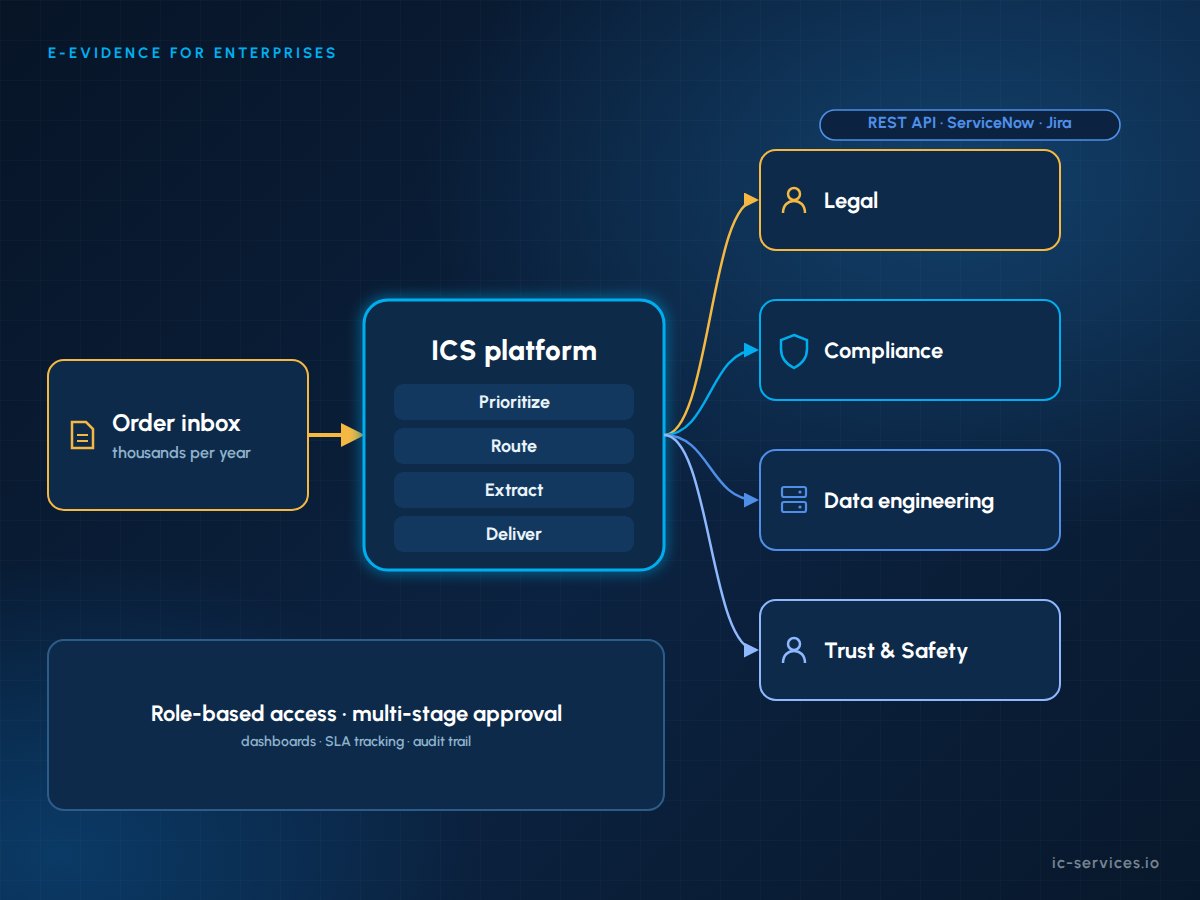
e-Evidence for enterprises is the operating model large platforms and telecom groups use to handle European production and preservation orders at scale. It links legal review, compliance approval and data extraction in one auditable workflow. Regulation (EU) 2023/1543, which sets the rules, has applied since 18 August 2026.
Key facts
- Audience: very large platforms, telecom groups, hyperscale cloud providers and pan-European operators.
- Volume: services with tens of millions of users can receive thousands of orders annually.
- Deadlines: EPOC within 10 days, or 8 hours in emergencies. EPOC-PR preservation for 60 days, extendable by 30 days.
- Integration: REST API with two-way sync to ServiceNow, Jira and case management tools.
- Non-EU platforms: need a legal representative in a participating Member State.
- Penalties: up to 2 % of total worldwide annual turnover.
Why do large platforms need e-Evidence for enterprises?
Very large platforms, telecom groups, hyperscale cloud providers and pan-European operators serve tens of millions of users. At that size, a provider can receive thousands of orders annually from authorities across the EU.
Each order has a fixed deadline: 10 days for a European Production Order Certificate (EPOC) and 8 hours in emergencies. A European Preservation Order Certificate (EPOC-PR) requires data to be preserved for 60 days, extendable by 30 days. Missing deadlines can lead to penalties of up to 2 % of worldwide annual turnover.
Volume is only part of the challenge. Orders involve several teams, several jurisdictions and several data systems. e-Evidence for enterprises brings these parts together in one controlled process. For the basics, see What is e-Evidence?
e-Evidence for enterprises: core capabilities
01
Multi-team workflow
Role-based access control, multi-stage approvals and team dashboards. Legal, compliance and data engineering each see what they need, with a full audit trail.
02
API-first integration
A bidirectional REST API connects the platform to ServiceNow, Jira and case management tools. Learn more
03
High-volume processing
Orders are prioritized by data category, urgency and jurisdiction. Bulk processing and dashboards keep large queues under control.
04
Workflow and extraction in one
The workflow and the data extraction backend run in one auditable platform. There is no gap between the decision and the data delivered.
05
Legal representative as a service
Non-EU platforms get a registered EU contact point that receives and validates orders. Learn more
06
Trust and safety augmentation
Security-cleared ICS staff can take over first-line review and escalate complex cases to your team.
How does an order move through the platform?
1
Intake
The order arrives through the secure exchange channel and is registered with its deadline.
2
First-line review
ICS or your team validates the issuing authority, checks jurisdiction and confirms formal requirements.
3
Prioritization
The order is ranked by data category, urgency and jurisdiction.
4
Approval
Legal and compliance reviewers sign off in defined stages, based on their roles.
5
Extraction
The backend collects exactly the requested data from your systems.
6
Delivery and sync
The response is sent, and status, objections and confirmations flow back to your ticketing tool.
How does the API connect to your existing tools?
Large platforms already run legal and trust and safety work in ticketing or case management systems. The ICS platform fits into that setup instead of replacing it.
- Inbound: new orders are routed into ServiceNow, Jira or your case management tool as tickets.
- Outbound: status changes, objections and confirmations are written back to the platform.
- Bidirectional: both sides stay in sync through the REST API.
- Controlled: role-based access control decides who can view, approve or release data.
The result is one source of truth for every order, with a full audit trail across teams.

Build vs buy: which approach fits e-Evidence for enterprises?
Many platforms first consider an in-house build. The table compares both options on the points that matter most in practice.
| Criterion | In-house build | ICS platform |
|---|---|---|
| Time to deploy | Depends on internal capacity and priorities | A ready platform built on the ICS LI and disclosure stack, typically faster to deploy than an in-house build |
| Workflow and extraction | Often separate tools that need their own integration | Workflow and data extraction backend in one auditable platform |
| Regulatory changes | Tracked and implemented by your own team | Tracked by ICS as part of the platform |
| Audit trail | Must be designed and maintained internally | Built in for every order and decision |
| 24/7 coverage | Requires your own on-call staffing | Can be supported by security-cleared ICS staff |
| EU contact point | Must be organized separately | Legal representative service available |
Legal representative as a service for non-EU platforms
Platforms without an EU establishment must appoint a legal representative in a participating Member State. ICS can take on that role and provides a registered EU contact point.
ICS receives and validates orders and carries out an initial legal assessment. Complex cases go to your Legal or Trust and Safety team. Legal representative and designated establishment service
How does trust and safety team augmentation work?
Security-cleared ICS staff can act as an extension of your trust and safety team. They handle the first-line review of incoming orders.
Their tasks include validating the issuing authority, checking jurisdiction and starting standard data extraction. Complex or sensitive cases are escalated to your in-house experts. Your team keeps control of every decision that needs legal judgment.
Why ICS
01
More than 20 years of disclosure experience
ICS has worked in lawful interception and data disclosure for more than two decades.
02
Security-cleared staff
Our team is security-cleared by the German Federal Ministry of the Interior and may handle classified information.
03
One stack for all duties
The platform is built on the same architecture as the ICS lawful interception and data retention stack.
04
EU-based partner
ICS is based in Cologne, Germany, which makes it a practical EU contact point for non-EU platforms.
Frequently Asked Questions
What is e-Evidence for enterprises?
e-Evidence for enterprises is an operating model for large platforms that receive many European production and preservation orders. It combines multi-team workflows, API integration, data extraction and an audit trail in one platform. ICS provides it for very large platforms, telecom groups, hyperscale cloud providers and pan-European operators. The Regulation behind these orders has applied since 18 August 2026.
How many orders can a large platform expect?
There is no fixed number, because volume depends on the service, user base and type of data held. Platforms with tens of millions of users can receive thousands of orders annually. Each order carries its own deadline of 10 days, or 8 hours in emergencies. That combination makes manual handling risky and makes prioritization essential.
Can the platform connect to ServiceNow or Jira?
Yes. The ICS platform is API-first and offers a bidirectional REST API. New orders can be routed into ServiceNow, Jira or other case management tools as tickets. Status updates, objections and confirmations flow back to the platform. Your teams keep working in familiar tools while the platform maintains the full audit trail and the deadlines.
Should we build our own e-Evidence solution or buy one?
An in-house build gives full control but requires your team to design workflows, extraction, audit trail and regulatory updates. ICS offers a ready platform built on its LI and disclosure stack. It is typically faster to deploy than an in-house build. It also combines workflow and data extraction backend in one auditable platform.
Can ICS act as our legal representative?
Yes, for platforms without an EU establishment. ICS provides a registered EU contact point in a participating Member State. The service includes receiving and validating orders and an initial legal assessment. Complex cases are routed to your Legal or Trust and Safety team. Your company remains responsible for compliance, and both you and your legal representative can be held liable.
What does trust and safety augmentation include?
Security-cleared ICS staff perform the first-line review of incoming orders. They validate the issuing authority, check jurisdiction and start standard data extraction. Cases that need legal judgment or involve unusual requests are escalated to your in-house team. This gives your experts more time for complex decisions while routine orders keep moving within the deadlines.
Scale e-Evidence without scaling headcount
We show how your legal, compliance and engineering teams can work in one auditable e-Evidence workflow.