
PREUVES ÉLECTRONIQUES
Plateforme de conformité en matière de preuves électroniques pour EPOC et EPOC-PR
Recevoir, valider et répondre dans les délais aux ordonnances européennes de production et de conservation. Une plateforme modulaire unique couvre la réception, l’extraction des données, la transmission et l’audit conformément au règlement (UE) 2023/1543.
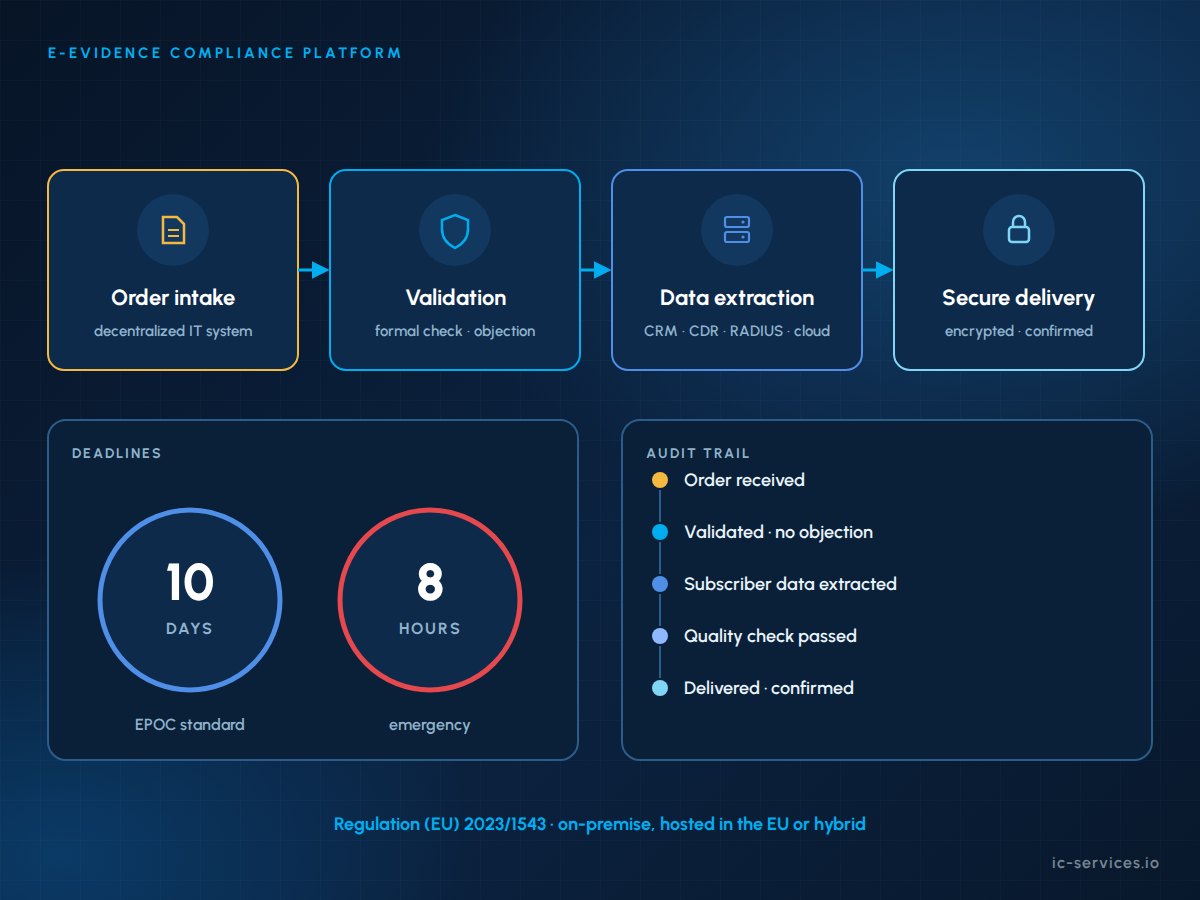
Une plateforme de conformité en matière de preuves électroniques est un logiciel qui permet aux prestataires de services de recevoir, de traiter et de répondre aux ordonnances européennes de production (EPOC) et aux ordonnances européennes de conservation (EPOC-PR) dans les délais légaux. La plateforme de conformité en matière de preuves électroniques ICS automatise ce cycle de vie conformément au règlement (UE) 2023/1543, depuis la réception de l’ordonnance jusqu’à l’extraction, la remise et l’audit des données.
Chiffres clés
- Base juridique : Le règlement (UE) n° 2023/1543 est applicable depuis le 18 août 2026. La directive (UE) n° 2023/1544 devait être transposée au plus tard le 18 février 2026.
- Dates limites : EPOC dans un délai de 10 jours, ou de 8 heures en cas d'urgence.
- Conservation : Les données EPOC-PR doivent être conservées pendant 60 jours, cette durée pouvant être prolongée de 30 jours.
- Sanctions : jusqu’à 2 % du chiffre d’affaires annuel mondial (art. 15).
- Échange : un système informatique décentralisé reposant sur e-CODEX, complété par des canaux nationaux.
- Déploiement : sur site, hébergé dans une infrastructure européenne gérée par ICS, ou en mode hybride.
Quelles sont les exigences du règlement sur les preuves électroniques ?
Le Règlement sur les preuves électroniques permet aux autorités judiciaires d'un État membre de l'UE d'ordonner à un prestataire de services situé dans un autre État membre de produire ou de conserver des preuves électroniques. Les prestataires doivent répondre directement, sans passer par la voie traditionnelle de l'entraide judiciaire.
Les délais sont courts, et le non-respect des obligations peut coûter cher. Le document d'accompagnement Directive (UE) 2023/1544 oblige les prestataires à désigner un destinataire. Les prestataires établis dans l'UE désignent un établissement désigné. Les prestataires situés en dehors de l'UE désignent un représentant légal.
| Commande | Objectif | Date limite |
|---|---|---|
| EPOC | Production de preuves électroniques | 10 jours après réception |
| EPOC (urgence) | Production en cas de menace imminente | 8 heures après réception |
| EPOC-PR | Conservation en attendant une demande ultérieure de production | Validité de 60 jours, prolongeable de 30 jours |
Modules de la plateforme de conformité « e-Evidence »
La plateforme est modulaire. Les prestataires commencent par les modules dont ils ont besoin et en ajoutent d'autres par la suite.
01
Moteur de prise de commandes
Reçoit les commandes via le système informatique décentralisé (basé sur e-CODEX) et les canaux nationaux. Analyse et valide chaque certificat, puis détermine le niveau d'urgence : 10 jours ou 8 heures.
02
Processus de contestation et de clarification
Traitement structuré des ordonnances incomplètes ou erronées, des cas d'impossibilité de fait et des préoccupations relatives aux immunités ou à la liberté de la presse, en utilisant le formulaire standardisé prévu par le règlement.
03
Module d'extraction de données
Adaptateurs pour les systèmes BSS/OSS, les référentiels CDR, les systèmes CRM, les journaux RADIUS/Diameter, le stockage dans le cloud et les bases de données. Des adaptateurs personnalisés permettent de connecter les systèmes internes.
04
Gestion de la préservation
Bloque les données demandées pour les commandes EPOC-PR, assure le suivi de la période de 60 jours et de toute prolongation éventuelle, et débloque les données à l'expiration de l'obligation.
05
Piste d'audit et rapports
Chaque étape est enregistrée. Les tableaux de bord et le suivi des SLA permettent de visualiser en un coup d'œil les commandes en cours, les dates limites et les délais de réponse.
06
Intégration avec la pile LI ICS
Reprend l'architecture de la pile ICS dédiée à l'interception légale et à la conservation des données. Réutilise les mêmes composants de transmission sécurisée et d'audit que le LIMS et la médiation ICS.
Comment la plateforme traite-t-elle une commande ?
1
Recevoir
La commande est transmise via le système informatique décentralisé ou un canal national, puis enregistrée avec un horodatage.
2
Valider et classer
La plateforme vérifie la forme et l'exhaustivité des données, identifie la catégorie de données et fixe la date limite.
3
Examen juridique
Votre équipe juridique examine la commande. Si nécessaire, elle déclenche une procédure de clarification ou d'opposition.
4
Extrait
Les adaptateurs extraient les données demandées des systèmes sources concernés et les classent selon les catégories prévues par le règlement.
5
Valider et livrer
Un utilisateur autorisé valide le résultat, puis la plateforme le transmet via ses composants de diffusion sécurisés.
6
Document
La piste d'audit enregistre chaque action, puis le dossier est clôturé ou conservé.
Quelles catégories de données la plateforme prend-elle en charge ?
Le règlement définit quatre catégories de données. Les ordonnances relatives aux données de trafic et aux données de contenu sont soumises à des conditions de délivrance plus strictes. Elles peuvent également nécessiter la notification de l'autorité chargée de l'exécution, ce qui a une incidence sur le moment où les données peuvent être transmises.
Le module d'extraction des données classe les données sources selon les catégories suivantes :
- Données relatives à l'abonné: par exemple, le nom, l'adresse et les détails du contrat issus du CRM ou du BSS.
- Données demandées dans le seul but d'identifier l'utilisateur: par exemple, les attributions d'adresses IP issues des journaux RADIUS/Diameter.
- Données sur le trafic: par exemple, les enregistrements de connexion provenant des référentiels CDR et de l'OSS.
- Données de contenu: par exemple, des fichiers ou des messages stockés dans des services de stockage dans le cloud et des bases de données.

Options de déploiement
| Option | Description | Coupe classique |
|---|---|---|
| Sur site | Fonctionne dans votre propre centre de données, sous votre contrôle | Opérateurs disposant d'une infrastructure LI existante |
| Hébergé | Fonctionne sur une infrastructure européenne gérée par ICS | Les prestataires qui privilégient un service géré |
| Hybride | Combinaison de composants hébergés et sur site, par exemple le traitement des commandes hébergé associé à une extraction locale des données | Fournisseurs qui conservent les données au sein de leur propre réseau |
À qui s'adresse une plateforme de conformité en matière de preuves numériques ?
01
Opérateurs de télécommunications et fournisseurs d'accès à Internet
Les fournisseurs de services de communications électroniques gèrent déjà les informations d'identification et la conservation des données. La plateforme étend ces mêmes processus aux commandes transfrontalières. En savoir plus
02
Cloud, SaaS et plateformes numériques
Les services d'hébergement, de messagerie et en ligne qui stockent ou transmettent des données d'utilisateurs reçoivent également des ordres. En savoir plus
03
Prestataires hors UE
Les prestataires établis en dehors de l'UE qui proposent des services au sein de l'Union doivent désigner un représentant légal. En savoir plus
Pourquoi ICS ?
01
Patrimoine de LI
Plus de 20 ans d'expérience dans le domaine des télécommunications et de l'interception légale, avec plusieurs agréments délivrés par la BNetzA.
02
Une pile
La plateforme de conformité e-Evidence réutilise des composants éprouvés en matière de mise en œuvre et d'audit issus de ICS LI et de la conservation des données.
03
Personnel habilité
Notre équipe dispose d'une habilitation de sécurité délivrée par le ministère fédéral allemand de l'Intérieur.
04
Assistance de bout en bout
Conseil, intégration, adaptateurs sur mesure et gestion des opérations, le tout auprès d'un seul et même partenaire.
Questions fréquemment posées
Qu'est-ce qu'une plateforme de conformité en matière de preuves numériques ?
Une plateforme de conformité en matière de preuves électroniques est un logiciel qui aide les prestataires de services à traiter les ordonnances européennes de production et les ordonnances européennes de conservation. Elle reçoit les ordonnances, les valide, assure le suivi des délais, extrait les données demandées des systèmes internes et documente chaque étape. La plateforme ICS couvre l’ensemble de ce cycle de vie conformément au règlement (UE) 2023/1543 et s’intègre aux systèmes existants de LI et de conservation des données.
Dans quels cas le règlement sur les preuves électroniques s'applique-t-il ?
Le règlement (UE) 2023/1543 est applicable depuis le 18 août 2026. La directive (UE) 2023/1544 qui l'accompagne devait être transposée dans le droit national au plus tard le 18 février 2026. Elle impose aux prestataires de désigner un établissement désigné ou, s'ils sont établis en dehors de l'UE, un représentant légal. Les prestataires devraient désormais avoir mis en place leurs processus et leurs systèmes.
Quels sont les délais de réponse pour l'EPOC et l'EPOC-PR ?
Une EPOC doit faire l'objet d'une réponse dans les 10 jours suivant sa réception. En cas d'urgence, le délai est de 8 heures. Une EPOC-PR impose au prestataire de conserver les données pendant 60 jours. Ce délai peut être prolongé de 30 jours si l'autorité émettrice a besoin de plus de temps pour répondre à une demande de communication de données. La plateforme assure automatiquement le suivi de chaque délai.
Comment les commandes sont-elles transmises aux prestataires ?
Les commandes et les communications associées sont échangées via un système informatique décentralisé basé sur e-CODEX. La plateforme ICS reçoit les commandes par l’intermédiaire de ce système et des canaux nationaux. Elle analyse et valide chaque commande, en détermine le niveau d’urgence et lance le processus de traitement. Cela évite la ressaisie manuelle des données relatives aux commandes et réduit le risque de non-respect des délais.
Que se passe-t-il si un prestataire ne respecte pas ces dispositions ?
Les États membres fixent les sanctions applicables en cas d’infraction. En vertu de l’article 15 du règlement (UE) 2023/1543, les sanctions pécuniaires peuvent atteindre jusqu’à 2 % du chiffre d’affaires annuel mondial total du prestataire au cours de l’exercice financier précédent. Un processus documenté, respectant des délais précis et assorti d’une piste d’audit complète aide les prestataires à démontrer qu’ils ont traité chaque commande correctement.
La plateforme peut-elle être hébergée par ICS ?
Oui. La plateforme peut fonctionner sur site, au sein d’une infrastructure européenne gérée par ICS ou dans un environnement hybride. Dans une configuration hybride, par exemple, le traitement des commandes peut s'effectuer dans l'environnement hébergé tandis que l'extraction des données reste au sein de votre réseau. ICS propose également des services d'établissement désigné et de représentant légal, permettant ainsi aux prestataires hors UE de combiner technologie et présence juridique.
Gérez vos commandes de production européennes en toute confiance
Découvrez comment la plateforme reçoit, traite et enregistre les commandes EPOC et EPOC-PR dans votre environnement.